
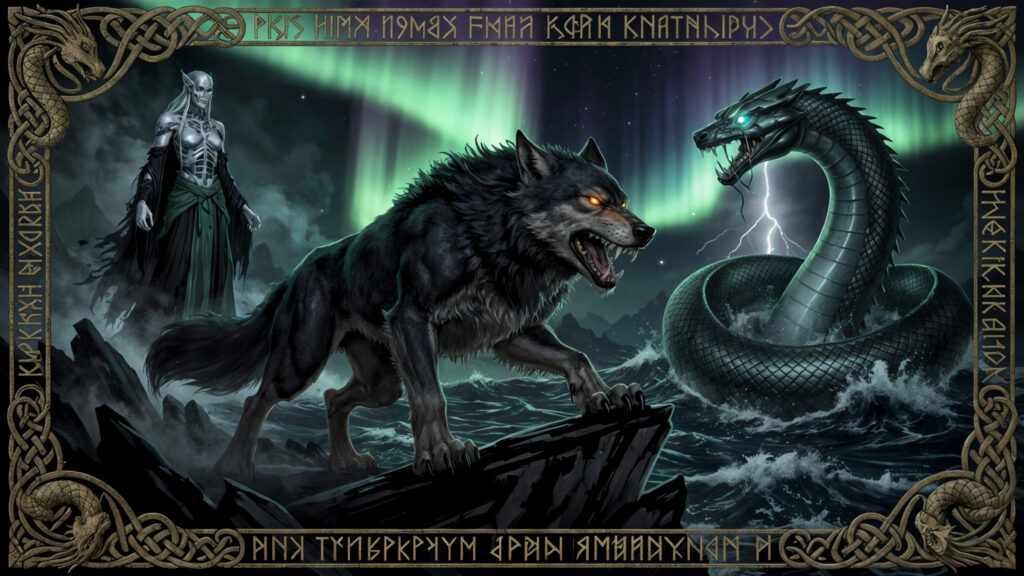
Loki fathered a wolf that would swallow Odin. He mothered a horse with eight legs. His daughter ruled the dead. And his serpent-son grew large enough to encircle the entire world.
No figure in Norse mythology produced offspring as strange, powerful, or terrifying as Loki. His children weren’t just monsters — they were cosmic forces woven into the fabric of fate itself. The gods feared them so deeply that they scattered them across the Nine Worlds at birth, yet that act of desperate separation only guaranteed the prophecy it tried to prevent.
Here’s who they were, where they came from, and why they mattered.
The Three Monster-Children: Born of Angrboda
Loki’s most infamous offspring came from his union with the giantess Angrboda, whose name translates to “She Who Offers Sorrow” — a fitting title for the mother of Ragnarok’s architects. According to Snorri Sturluson’s Gylfaginning in the Prose Edda, when the gods learned that these three children were being raised in Jotunheim, they also learned of prophecies foretelling catastrophe. Odin sent gods to retrieve them and dealt with each one separately.
Fenrir — The Wolf Who Would Eat the Sun
Fenrir (Old Norse for “fen-dweller,” also called Hrodvitnir or “fame-wolf”) was the eldest of Angrboda’s children with Loki. Unlike his siblings, the gods didn’t immediately exile him. They raised Fenrir in Asgard, perhaps thinking they could control what they couldn’t destroy.
They were wrong. Fenrir grew at an alarming rate, and only Tyr, the god of war and justice, dared to feed him.
When the wolf became too large and too dangerous, the gods tried to bind him — twice with ordinary chains. They presented these as tests of strength, flattering his vanity. Fenrir snapped through Leyding and Dromi like thread.
The third attempt required something extraordinary. The dwarves forged Gleipnir, a ribbon-thin binding made from six impossible ingredients: the sound of a cat’s footstep, the beard of a woman, the roots of a mountain, the sinews of a bear, the breath of a fish, and the spittle of a bird. The old Norse sources claimed these things no longer exist in our world because the dwarves used them all.
Fenrir sensed treachery. He agreed to be bound only if one of the gods placed a hand in his mouth as a pledge of good faith. Only Tyr volunteered. When Fenrir realized he couldn’t break free, he bit off Tyr’s right hand at the wrist — the most famous sacrifice of trust in all of Norse mythology.
At Ragnarok, Fenrir breaks his chains. He swallows Odin whole. But Odin’s son Vidar avenges his father by either tearing the wolf’s jaws apart or driving a sword through its heart, depending on which source you follow.
Jörmungandr — The World Serpent
Odin hurled the second child into the great ocean surrounding Midgard. There, Jörmungandr (literally “huge monster” in Old Norse) grew until he encircled the entire world, gripping his own tail — an ouroboros figure that held the cosmos together. When he eventually releases that tail, it signals that Ragnarok has begun.
Thor and the World Serpent share one of mythology’s great recurring rivalries, meeting three times across the surviving sources.
Their first encounter happened at the hall of the giant Utgarda-Loki, where Jörmungandr was disguised as an enormous cat. Thor was challenged to lift it. Despite his legendary strength, Thor managed to raise only one paw off the ground — and Utgarda-Loki later revealed the “cat” was actually the Midgard Serpent. The fact that Thor lifted even a portion of it terrified every giant in the hall.
The second meeting came during Thor’s fishing trip with the giant Hymir, recorded in the Eddic poem Hymiskviða. Using an ox head as bait, Thor hooked Jörmungandr and hauled him toward the surface. The two locked eyes. In some versions, Hymir cut the line in terror before Thor could strike. This scene was so iconic that it appears carved on the Altuna runestone in Sweden, dating to roughly the 11th century — physical proof of how central this myth was to Norse culture.
Their third and final meeting comes at Ragnarok. Thor kills the serpent but staggers nine steps before collapsing dead, poisoned by its venom. Neither survives. It’s one of the most striking mutual destructions in any mythology.
Hel — Queen of the Dead
Odin sent the third child to Niflheim, the realm of cold and mist, and gave her dominion over everyone who dies of sickness, old age, or any death that isn’t heroic combat. He essentially made her ruler of the majority of all human dead — a staggering amount of power to hand to the daughter of his greatest enemy.
Snorri describes Hel as half-alive and half-dead, with a gloomy and fierce appearance. Her hall is called Éljúðnir (“sprayed with snowstorms”), her dish is Hunger, her knife is Famine, her bed is Sickbed, and her bed-curtains are called Gleaming Bale. Every detail of her existence speaks to misery — but also to sovereignty.
Her most significant myth involves the death of Baldr, Odin’s beloved son. After Loki engineered Baldr’s killing (through the blind god Hodr and a spear of mistletoe), the god Hermod rode Sleipnir — Loki’s own child — down to Hel’s realm to plead for Baldr’s return.
Hel set a condition: if everything in the world, living and dead, wept for Baldr, she would release him. Everything did weep. Except one giantess named Thökk, who most scholars believe was Loki himself in disguise. “Let Hel hold what she has,” Thökk declared. Baldr stayed dead.
At Ragnarok, Hel commands an army of the dead who sail to the final battle aboard Naglfar — a ship built entirely from the fingernails and toenails of the deceased. In the Poetic Edda’s Völuspá, Loki himself steers this nightmarish vessel.
Sleipnir — The Eight-Legged Horse
This is the story that makes people do a double-take. Loki didn’t father Sleipnir. He mothered him.
An unnamed giant offered to build an impenetrable wall around Asgard in exchange for the sun, the moon, and the goddess Freyja. The gods agreed — on the condition that the builder finish within a single winter, with no help except his stallion Svadilfari (“unlucky traveler”).
They assumed failure was guaranteed. They were nearly wrong. Svadilfari performed incredible feats of strength, hauling enormous boulders at supernatural speed. With three days left, the wall was almost complete.
The gods blamed Loki for proposing this deal and threatened him with death unless he sabotaged the work. Loki shapeshifted into a beautiful mare, lured Svadilfari away from the construction site, and ran through the forests all night. Without his horse, the builder couldn’t finish in time. He flew into a rage, revealing himself as a giant, and Thor killed him with Mjölnir.
Some time later, Loki returned to Asgard with a foal — an eight-legged grey horse that Snorri calls “the best of all horses.” Odin took Sleipnir as his own mount, riding him between worlds and eventually into the final battle at Ragnarok.
The gender fluidity displayed in this myth isn’t accidental. In Lokasenna (the Eddic poem where Loki insults every god at a feast), Odin taunts Loki specifically about having given birth. Loki fires back that Odin practiced seiðr, a form of magic considered feminine. Neither is embarrassed by the other’s accusation — the Norse didn’t process gender the way modern Western cultures do, and these myths reflect a cosmology where transformation and boundary-crossing were fundamental to power.
Narfi and Váli — The Forgotten Sons
Loki’s children with his wife Sigyn rarely get the attention they deserve, probably because their story is almost unbearably grim — even by Norse standards.
After Loki orchestrated Baldr’s death and then mocked every god at Aegir’s feast in the Lokasenna, the Aesir finally turned on him. They captured Loki and brought his two sons, Narfi (also called Nari) and Váli, before him.
The gods transformed Váli into a wolf. In his animal madness, he tore his brother Narfi apart. The gods then used Narfi’s intestines to bind Loki to three flat stones, and the bonds hardened into iron. A serpent was placed above his face, dripping venom onto him for eternity.
Sigyn stayed. She held a bowl above Loki’s face to catch the venom. But every time the bowl filled and she turned to empty it, drops of venom struck Loki’s skin, causing him to writhe in such agony that the earth shook. The Norse believed this explained earthquakes.
A note on naming confusion: Loki’s son Váli is frequently mixed up with Odin’s son Váli — a completely different figure who avenges Baldr by killing Hodr. Some scholars, including John Lindow, suspect this overlap may stem from textual corruption in the manuscript tradition rather than intentional mythological design.
The Mother of All Witches
There’s one more offspring attributed to Loki that most popular retellings skip entirely.
In the Völuspá hin skamma — a poem embedded within the Hyndluljóð of the Poetic Edda — Loki finds the half-burnt heart of a wicked woman (sometimes identified as Angrboda herself, sometimes as an unnamed figure). He eats it. From this act, he becomes pregnant and gives birth to all female monsters or witches (Old Norse: flagð).
This makes Loki the mythological mother of witchcraft itself — a detail that deepens his role as a figure who crosses every boundary the Norse world constructed: between gods and giants, between male and female, between creation and destruction.
Why the Gods Created Their Own Doom
The thread connecting all of Loki’s children is a brutal irony. The gods received prophecies about these offspring bringing destruction, and every action they took to prevent it — exiling Jörmungandr, binding Fenrir, appointing Hel over the dead — only positioned those children exactly where they needed to be when Ragnarok arrived.
Jörmungandr grew large enough to poison the sky because Odin threw him in the ocean. Hel built an army of the dead because Odin gave her sovereignty over Niflheim. Fenrir’s rage burned for an eternity of imprisonment because the gods tricked and bound him. Even Narfi’s entrails, used to chain Loki, only ensured that when those bonds finally broke, Loki would have nothing left but vengeance.
The Norse understood something about fate that later mythological traditions often softened: knowing the future doesn’t help. The Norns weave what they weave. The gods were brave, often noble, and entirely doomed — not despite their efforts, but because of them.
Loki’s children are the instruments of that doom, and the stories about them remain among the most psychologically complex and narratively powerful in all of world mythology.
