
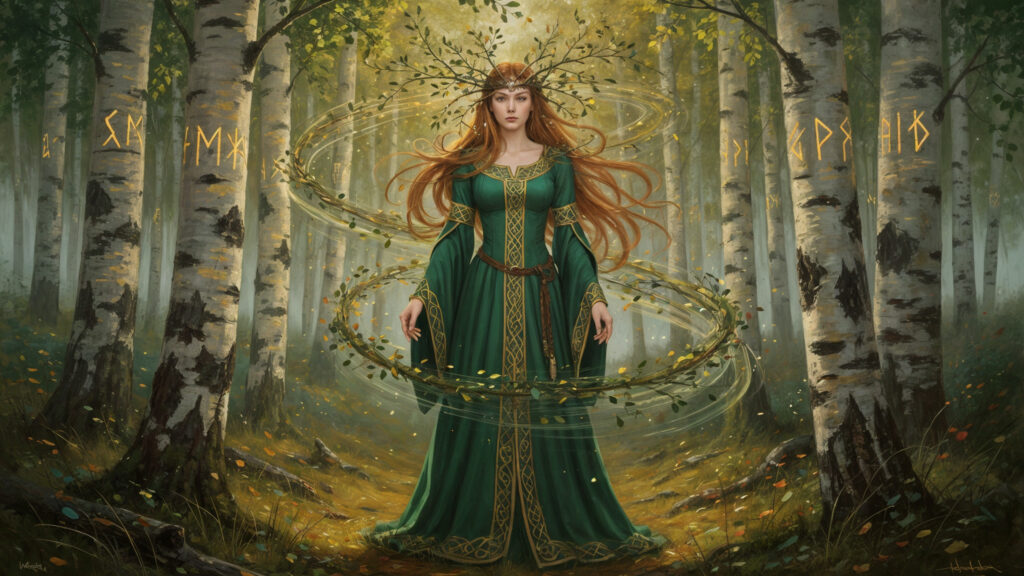
Few figures in Norse mythology are as shrouded in mystery as Laufey — the mother of Loki, the trickster god who would shake the foundations of Asgard itself. While Odin, Thor, and even Loki dominate the sagas, Laufey lingers in the shadows, mentioned only in fragments. Yet those fragments reveal a figure far more fascinating than most realize.
So who was Laufey, and why does she matter? Let’s unravel everything the ancient sources tell us — and what they leave tantalizingly unsaid.
Who Is Laufey in Norse Mythology?
Laufey is identified in the Old Norse sources as the mother of Loki. Her name appears primarily in the Prose Edda and the Poetic Edda, the two foundational texts of Norse mythology compiled in 13th-century Iceland.
What makes Laufey unusual is that Loki is frequently referred to as “Loki Laufeyjarson” — Loki, son of Laufey — rather than being identified through his father, Farbauti. In a patrilineal Norse society where children were almost always named after their fathers, this matronymic naming is striking and nearly unique among the gods.
This has led scholars to debate for centuries: Was Laufey of higher status than Farbauti? Was there something about her lineage or nature that made her the more important parent?
The Meaning of the Name “Laufey”
The name Laufey is generally interpreted as meaning “leafy” or “full of leaves,” derived from Old Norse lauf (leaf) and -ey, which could mean “island” or be a feminine suffix.
Some scholars have connected her name to the natural world, seeing Laufey as a personification of foliage or woodland. This interpretation gains weight when paired with her husband Farbauti, whose name means “cruel striker” or “dangerous hitter” — often interpreted as lightning.
The poetic image emerges: lightning (Farbauti) strikes the leaves (Laufey), and from that union comes fire — Loki, whose very nature is associated with flame, chaos, and transformation. Whether the Norse poets intended this elemental metaphor or later scholars read it into the myth, it remains one of the most compelling interpretations of Loki’s parentage.
Laufey and Farbauti: A Union of Elemental Forces
Farbauti is identified as a jötunn — a giant — making Loki half-giant by blood. Laufey’s own nature is less clear. Some sources suggest she was also a giantess, while others leave her origins ambiguous.
The Prose Edda written by Snorri Sturluson states simply that Loki’s mother was “Laufey or Nál.” This casual “or” has generated enormous scholarly discussion. Are Laufey and Nál the same person with two names? Or are they different traditions about Loki’s mother that Snorri chose not to reconcile?
The name Nál means “needle,” which some interpret as a reference to slenderness or sharpness — possibly describing her physical appearance or her character. If Laufey and Nál are indeed the same figure, she carries both the softness of leaves and the sharpness of a needle, a duality that fits perfectly as the mother of the most contradictory god in the Norse pantheon.
Why Is Loki Called “Son of Laufey” Instead of His Father?
This is perhaps the most debated question surrounding Laufey. In Norse culture, a matronymic — being identified through your mother — was rare and could carry various implications:
Higher status of the mother. If Laufey was of nobler birth than Farbauti, Norse convention might favor naming Loki through her line. Some scholars suggest Laufey may have been a goddess or a figure of significant standing among the jötnar.
Illegitimacy or unusual birth. In some Norse contexts, matronymics were used when the father was unknown, absent, or when the circumstances of conception were unusual. Given Loki’s nature as a shapeshifter and boundary-crosser, an unconventional birth would fit his character.
Emphasis on the maternal line. Some researchers argue this reflects an older, possibly pre-Viking tradition where maternal lineage held more cultural weight than it did by the time the Eddas were written down.
A lost mythology. Perhaps the most likely explanation is that stories about Laufey once existed that made her the more memorable parent — stories that were lost before Snorri and the other compilers set the myths to parchment.
Laufey in the Poetic Edda and Prose Edda
Laufey’s appearances in the primary sources are brief but significant:
In the Poetic Edda, particularly in Lokasenna (Loki’s Flyting), Loki is referred to as “Laufey’s son” multiple times. During this poem, where Loki insults each of the gods at a feast, his maternal identification is used almost like a title.
In the Prose Edda, Snorri Sturluson mentions Laufey in his account of Loki’s family. He writes: “Loki is handsome and fair of face, but evil in disposition and very changeable in his ways. His father was the giant called Farbauti, and his mother Laufey or Nál.”
Beyond these references, Laufey does not appear as an active character in any surviving myth. She doesn’t speak, act, or intervene in any recorded story. She exists solely through her relationship to Loki — yet that relationship proved important enough to define how the gods themselves addressed her son.
Laufey’s Legacy in Modern Culture
The mystery surrounding Laufey has made her a compelling figure for modern storytellers:
In Marvel Comics and the MCU, Laufey was reimagined as a male Frost Giant king — the father, not the mother, of Loki. This dramatic departure from the source material created a compelling villain but bears little resemblance to the mythological Laufey.
In the God of War video game series, Laufey (called “Faye”) plays a crucial role as Kratos’s wife and Atreus’s mother, bringing her closer to her mythological roots as a figure of quiet power whose influence shapes the entire narrative.
The Icelandic-Chinese singer Laufey (Laufey Lín Zon Jónsdóttir) has also brought renewed attention to the name, though her connection is to Icelandic naming traditions rather than a deliberate mythological reference.
What Happened to Laufey?
The myths are silent on Laufey’s fate. She is not mentioned in the events of Ragnarök. She does not appear among those who survive the end of the world. She simply… fades from the narrative after her son’s introduction.
This absence is itself telling. Many minor Norse figures receive at least a mention during the apocalyptic final battle, yet Laufey — mother of one of the most important figures in that cataclysm — is nowhere to be found.
Some scholars speculate that Laufey’s story was once fuller and more detailed, but that it was among the many myths lost during the Christianization of Scandinavia. Others suggest she was always a background figure — important not for her own deeds but for what she produced.
The Deeper Significance of Laufey
Laufey represents something important about Norse mythology that is easy to overlook: the tradition was never a single, unified system. It was a living, evolving collection of stories told by different peoples across centuries and vast distances. Laufey’s fragmentary presence reminds us that what survives in the Eddas is only a fraction of what once existed.
She also represents the feminine divine in Norse mythology — not as a warrior goddess or a weaver of fate, but as a generative force. The leaf-mother who, struck by lightning, brings forth fire. In a mythology filled with violence and heroism, Laufey offers a glimpse of something more elemental: the quiet power of creation itself.
Quick Facts About Laufey
- Name meaning: “Leafy” or “Leaf Island”
- Also known as: Nál (“Needle”)
- Husband: Farbauti (a jötunn)
- Most famous child: Loki
- Primary sources: Prose Edda, Poetic Edda (Lokasenna)
- Notable trait: One of the rare Norse figures whose child bears a matronymic name
- Modern adaptations: Marvel (reimagined as male), God of War (as “Faye”), namesake of singer Laufey
The mysteries of Norse mythology run deeper than the well of Urd. Laufey may speak no words in the surviving sagas, but her presence echoes through every tale of Loki — the fire born from leaves and lightning.
