
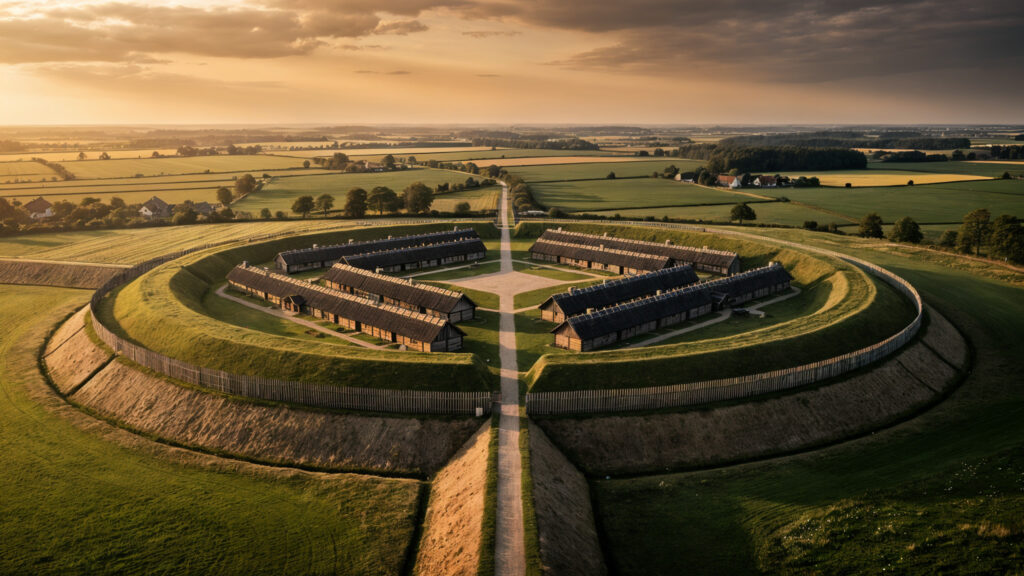
In 1936, a motorcycle club outside the Danish town of Slagelse stumbled onto something unexpected while building a practice track. Beneath the topsoil lay the remains of a massive circular fortress — perfectly geometric, precisely engineered, and roughly a thousand years old. This was Trelleborg, the first of Denmark’s Viking ring fortresses to be excavated, and it shattered the popular image of Norsemen as disorganized raiders who only knew how to destroy.
The Trelleborg fortresses represent some of the most ambitious construction projects in early medieval Northern Europe. Built during the reign of Harald Bluetooth in the late 10th century, these structures demanded a level of mathematical precision, material science, and organized labor that rivals anything the Romans left behind in Scandinavia.
What Exactly Were the Ring Fortresses?
Four confirmed ring fortresses have been identified in Denmark: Trelleborg near Slagelse, Fyrkat near Hobro, Aggersborg near Limfjorden, and Nonnebakken in Odense. A fifth, Borgring near Køge, was confirmed through aerial surveys and excavation in 2014. Sweden’s Trelleborg near Malmö shares the name but differs slightly in design.
Each fortress followed an almost identical blueprint. A perfectly circular rampart enclosed a symmetrical arrangement of longhouses, with streets intersecting at precise right angles. The geometric accuracy is startling — Fyrkat’s inner diameter measures exactly 120 meters, and the deviation from a true circle is less than half a meter across the entire structure. That kind of precision required sophisticated surveying tools and a deep understanding of geometry.
The ramparts themselves were massive earthwork and timber constructions. At Trelleborg, the circular wall stood roughly 5 meters high and 17 meters thick at the base, built from compacted earth reinforced with timber framing. A wooden palisade topped the rampart, and a V-shaped ditch — 4 meters deep and 17 meters wide — encircled the entire complex.
The Construction Process
Building a ring fortress was a colossal undertaking. Archaeologists estimate that Aggersborg, the largest at 240 meters in diameter, required the movement of roughly 30,000 cubic meters of earth. Without modern equipment, every cubic meter was dug, carried, and compacted by hand or with simple tools — wooden shovels, woven baskets, and timber sledges.
The process started with surveying. The builders established a central point, then used a long rope or chain to scribe a perfect circle in the ground. From this circle, they laid out the cardinal axes and positioned the longhouse foundations with remarkable consistency. At Fyrkat, all sixteen longhouses within the walls measure 28.5 meters in length, with identical curved walls and interior divisions.
Foundation work required clearing and leveling the ground, then laying courses of stone and packed earth. The longhouse walls used a technique called stave construction — upright timbers set into a ground sill, with wattle-and-daub or plank infill between the posts. Roofs were covered with wooden shingles or turf, depending on local materials.
The ramparts demanded the most labor. Workers dug the surrounding ditch first, using the excavated material as fill for the embankment. Layers of earth were alternated with timber lattice frameworks — horizontal logs laid crosswise to stabilize the mass and prevent slumping. This technique, called kastenwerk in archaeological literature, created a structure that could withstand both weather and assault.
Materials and Logistics
Timber was the primary building material, and the quantities required were staggering. Dendrochronological studies (tree-ring dating) of timbers from Trelleborg show that the fortress was built around 980-981 CE, with most wood cut during a single winter season. This means Harald Bluetooth’s builders felled thousands of oak trees in a coordinated logging operation, then transported and shaped them on-site within months.
Oak was preferred for structural timbers — posts, beams, and the palisade atop the rampart. Softer woods like willow and hazel were used for wattle screens and lighter construction. Stone played a supporting role, particularly in foundation courses and drainage channels. At Aggersborg, archaeologists found evidence of limestone being quarried locally and used to stabilize the longhouse foundations.
The logistics of supplying a construction site this large would have been formidable. Workers needed food, tools, and raw materials delivered continuously. Iron nails and fittings, while used sparingly compared to later medieval construction, still required smithing operations on or near the site. Several of the fortresses show evidence of smithies operating during the construction phase.
Who Built Them — And Why?
The ring fortresses are universally attributed to Harald Bluetooth, the king who unified Denmark and converted the Danes to Christianity. Their construction dates cluster tightly around 980 CE, suggesting a centralized royal building program rather than local initiatives.
The purpose remains debated. Early theories proposed them as military barracks for assembling invasion fleets — possibly the force that attacked England in the 980s and 990s. But excavations revealed a more complex picture. Fyrkat’s graves include women and children, some buried with jewelry and household goods. Trelleborg housed craftspeople alongside warriors. These weren’t purely military installations.
The current consensus leans toward the fortresses serving multiple functions: military staging areas, administrative centers for royal authority, and demonstrations of power. Harald was consolidating control over a recently unified Denmark while simultaneously managing the conversion to Christianity. Massive, geometrically perfect fortresses — built with speed and precision — sent an unmistakable message about the king’s organizational capacity and resources.
Engineering Sophistication
What makes the ring fortresses remarkable isn’t just their size but their mathematical consistency. The basic unit of measurement appears to have been a “Viking foot” of approximately 29.5 centimeters, and all major dimensions are clean multiples of this unit. The inner diameter of the standard-sized fortresses (Trelleborg, Fyrkat, Nonnebakken) equals roughly 405 Viking feet. Longhouse lengths, street widths, and gate placements all conform to the same modular system.
This standardization implies the existence of a master plan — possibly drawn or encoded in some portable format — that could be replicated across multiple sites by different construction teams. It also implies a class of skilled surveyors and engineers who traveled with the building crews.
The drainage engineering deserves special mention. Viking-age Denmark was (and is) wet. The fortress builders installed wooden-lined drainage channels beneath the streets and around the longhouse foundations, directing rainwater out through culverts in the rampart wall. At Fyrkat, these drains still show the original timber lining, preserved in waterlogged conditions for over a thousand years.
The Afterlife of Viking Construction
The ring fortresses were occupied for a surprisingly short period — perhaps only 10 to 20 years. After Harald Bluetooth’s death around 985-986 CE, they fell into disuse. His son Sweyn Forkbeard apparently had no need for them, or perhaps the political conditions that made them useful had passed.
But the construction knowledge didn’t vanish. Scandinavian building techniques evolved through the medieval period, and the timber-and-earth construction methods used in the ring fortresses have parallels in later Scandinavian architecture. The stave churches of Norway, built from the 11th century onward, share DNA with Viking-age stave construction — the same principle of upright timbers anchored in a foundation sill.
Modern archaeologists have attempted to reconstruct sections of the fortresses using period-appropriate tools and methods. These experimental archaeology projects reveal just how labor-intensive the work was. A team of volunteers reconstructing a section of Trelleborg’s rampart found that even with knowledge of the techniques, the physical effort of moving and compacting earth by hand was grueling. Contemporary construction relies on heavy machinery — concrete recycling equipment, excavators, and compactors — that would have seemed like the work of the gods to a 10th-century foreman.
The ring fortresses remain one of the Viking Age’s most impressive legacies. They prove that the Norse weren’t just skilled shipbuilders and warriors but also architects and engineers capable of projects that required centralized planning, mathematical precision, and the organized labor of hundreds. When you stand inside the reconstructed walls at Trelleborg today, the scale of what Harald Bluetooth accomplished in a single building season still feels difficult to believe.
