
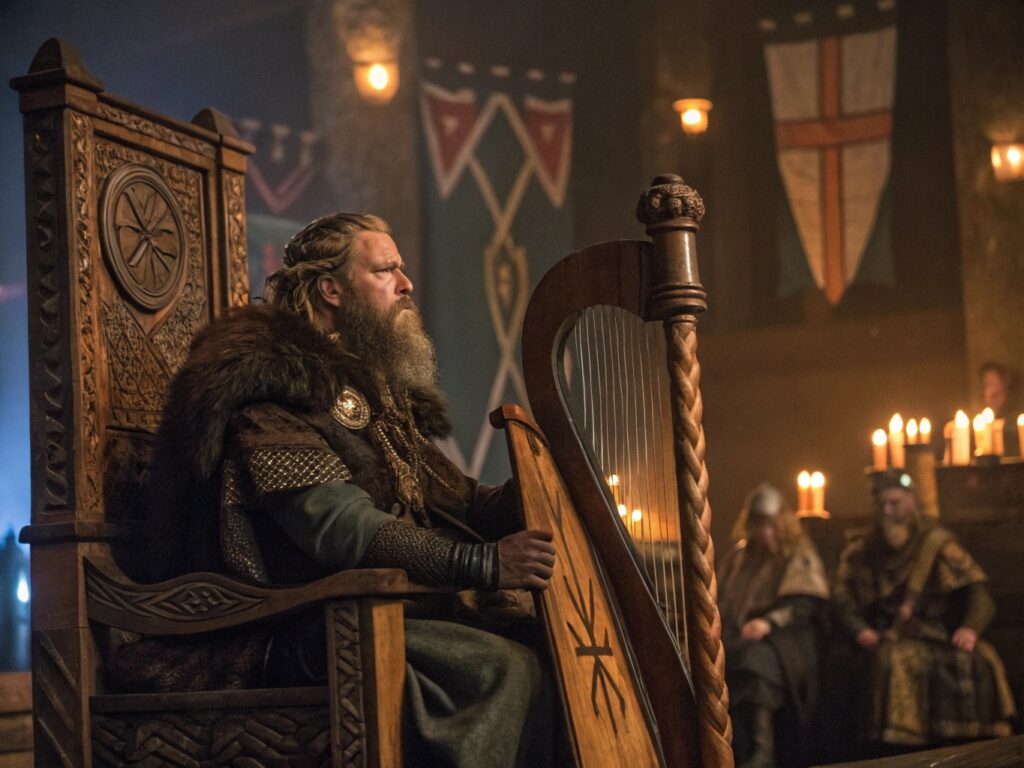
The Forgotten Voice of the Norse Pantheon
When people think of the Norse gods, mighty figures like Odin, Thor, or Loki usually dominate the imagination. Yet among the pantheon of Asgard stands a lesser-known but deeply influential deity: Bragi son of Odin, the Norse god of poetry, eloquence, and storytelling. Unlike Thor’s hammer or Odin’s ravens, Bragi’s power did not lie in weapons or prophecy—it lived in words. His domain was skaldic poetry, memory, and the oral traditions that carried Viking culture across generations.
This article explores who Bragi son of Odin was, his role in mythology, his marriage to Idunn, his connection to the mead of poetry, and the importance of words in Viking culture.
Bragi Son of Odin: The Norse God of Poetry
Origins and Identity
Bragi son of Odin is described in the Prose Edda by Snorri Sturluson as the god of poetry and song. Some traditions present him as Odin’s divine child, while others suggest he may have once been a historical skald whose memory transformed into godhood. What remains consistent is his identity as the god of poetry and eloquence, with a long beard, runes carved on his tongue, and wisdom flowing from his words.
Unlike gods of war, Bragi wielded no sword. His weapon was the spoken word, and in Norse belief, that was as powerful as any blade.
Bragi and Idunn: The Keeper of Youth
Bragi’s wife was Idunn, goddess of eternal youth, who guarded the apples that kept the gods from aging. This union between Bragi and Idunn symbolized the marriage of memory and renewal. Words, like Idunn’s apples, had the power to keep culture alive, renewing traditions across generations.
The gods relied on Idunn’s fruit to sustain them—just as Viking communities relied on skalds, bards, and oral poets to preserve their heritage.

Bragi in the Halls of Valhalla
In myth, Bragi Norse mythology often places him in Valhalla, where he welcomes fallen warriors with poetry. As a skald, he greeted heroes not with weapons but with words, shaping their legacy in song. This shows how even in a warrior culture, poetry was central to identity. To die bravely was not enough; one needed a skald to tell the story, ensuring fame lived on.

Skaldic Poetry: The Power of Words in Viking Culture
What Is Skaldic Poetry?
Skaldic poetry was a complex, tightly structured form of verse unique to the Viking Age. Unlike the simpler Eddic poetry, it was filled with kennings (metaphorical phrases, like calling the sea “whale-road”) and demanding meters.
Bragi the Skald
The title Bragi the Skald reflects his role as patron of this art form. Skalds were not mere entertainers—they were historians, political commentators, and memory-keepers. In a society without widespread literacy, the poet’s role was essential.
A king could win battles, but without a skald, his victories might be forgotten. Words immortalized deeds, and in this sense, Bragi son of Odin was as powerful as any war-god.
The Mead of Poetry: Gift and Burden
One of the most famous myths tied to Bragi Norse mythology is the mead of poetry. After the gods created this magical mead from the blood of the wise being Kvasir, it became the source of all poetic inspiration. Whoever drank it gained the gift of eloquence.
Odin himself stole the mead and shared it among the gods and chosen humans. As god of poetry, Bragi embodied this gift, channeling the divine power of words. In Viking belief, poetry was not just creativity—it was a sacred force flowing from the gods to mortals.
Memory and Storytelling in Viking Society
Oral Tradition as Cultural Survival
For the Norse, memory was life. In a world without books or mass literacy, culture survived through storytelling traditions. Myths, sagas, genealogies, and laws all lived in the spoken word. To forget was to lose identity.
Bragi, as god of memory and song, represented the bridge between past and present. He kept the deeds of gods and men alive, ensuring that no great warrior or story faded into silence.
Viking Skalds as Cultural Guardians
Skalds often traveled between courts, praising kings or criticizing rulers through verse. They shaped reputations and could immortalize—or destroy—a leader’s legacy. This cultural weight explains why the Vikings revered Bragi the Skald.
Bragi and the Power of Eloquence
Unlike Thor’s thunder or Loki’s chaos, Bragi’s power was subtle but transformative. Words could inspire warriors, seal alliances, or preserve a name for centuries.
In Viking culture, the ability to speak well was as valuable as fighting skill. Leaders needed eloquence to command loyalty. A poem could outlast kingdoms, giving Bragi a timeless role as the god of cultural immortality.
Bragi in the Eddas
The Prose Edda and Poetic Edda contain references to Bragi. In Skáldskaparmál, Bragi appears as a wise figure explaining the nature of poetry to other gods. This reinforces his role as teacher and guardian of tradition.
Though not as prominent as Odin or Thor, his presence anchors the Norse worldview: power was not only in war, but in memory, song, and story.
Symbolism of Bragi Son of Odin
Bragi symbolizes three key themes in Norse mythology:
-
Poetry as Power – Words shape reality and preserve identity.
-
Memory as Immortality – What is remembered cannot die.
-
Eloquence as Strength – True authority lies in speech as much as in battle.
For the Vikings, these values were not abstract. They guided how leaders ruled, how warriors sought fame, and how ordinary people passed down their culture.
Conclusion: Why Bragi Still Matters
Today, Bragi may seem overshadowed by gods of thunder or mischief. Yet his influence endures in every saga, poem, and story that survived from the Viking Age. Without him, the Norse myths themselves might have been lost.
Bragi son of Odin, the Norse god of poetry, is more than a myth—he is a reminder of the power of words. In a culture where swords won battles but poems won eternity, Bragi was the silent force that ensured the Viking spirit lived on.
