
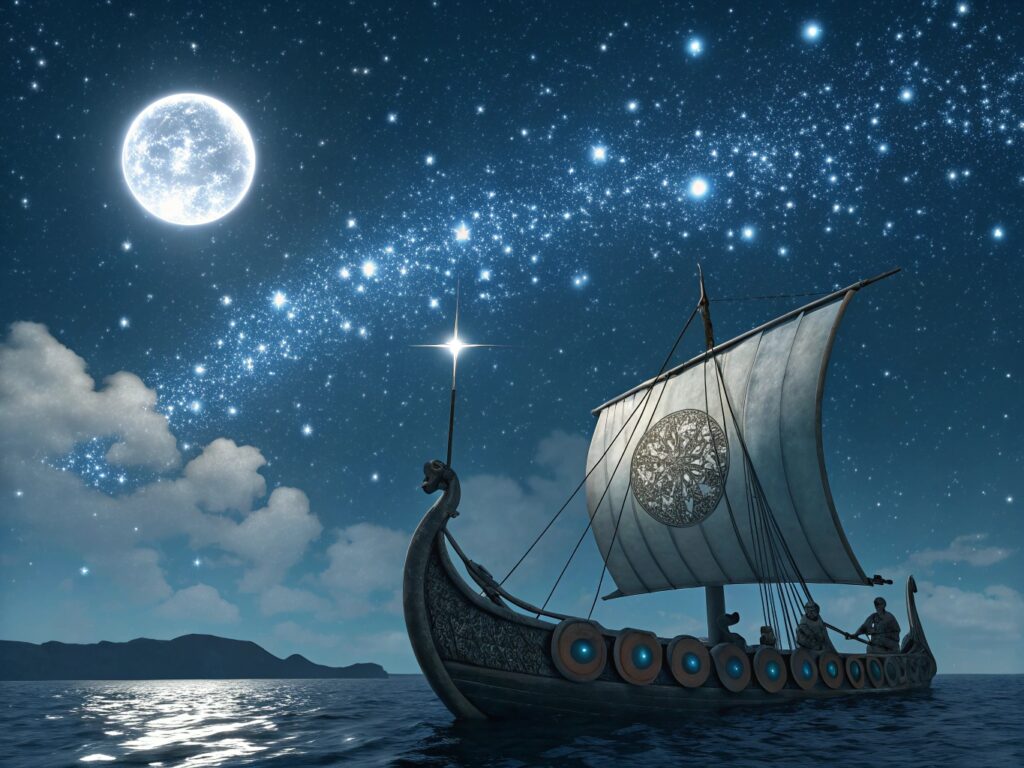
To know where the Vikings went, firstly, you have to know what they thought!
The Vikings were no sailors and warriors. They were oral historians, poets, and religious philosophers who sailed with a full cosmology in their minds across seas and shaped colonies in distant lands.
Behind every voyage was a map—not a map of stars and coastline, but a map of myth, meaning, and sacred cosmos.
This is a history of how cosmology and exploration among the Norse were intimately related—how the Viking world view established not just where they traveled, but why they traveled where they did.
The Norse Universe: Nine Worlds According to Myth
The Viking mind did not see the world as flat or round. It saw it as a tree.
At the center of Norse cosmology was the World Tree, Yggdrasil, a vast, sacred ash that connected all planes of existence. The sacred tree was the religious axis mundi, or world axis, around which orbited the universe.
The Nine Worlds tied together by Yggdrasil were:
- Asgard – The world of Aesir gods
- Midgard – The human world or Earth
- Vanaheim – Home to the Deities of Fertility
- Jotunheim – The land of giants
- Alfheim – The kingdom of the light elves
- Svartalfheim – The kingdom of dwarves
- Niflheim – The ice and fog world
- Muspelheim – The Fire Realm
- Helheim – The home of dead individuals
These were no abstractions. They were concrete levels of existence—to the Norse, geographical, psychological, and spiritual. The boundaries between them could be overstepped by ritual, by vision, or by travel.
Thus, as they navigated to new lands to their west, they did not just see new country—they saw new kingdoms.
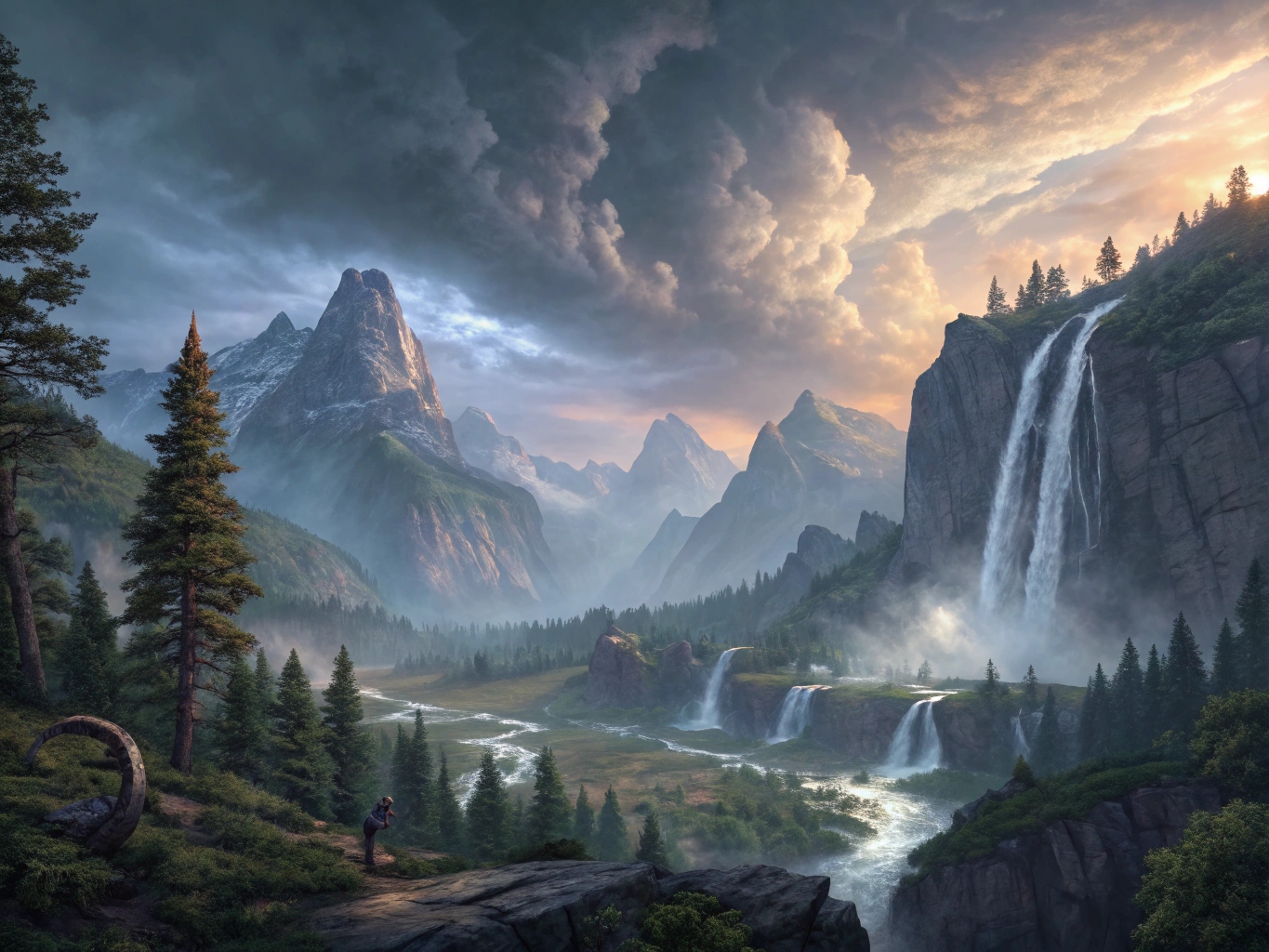
Cosmology as Compass: The Mythic Geography of the Viking Mind
The Norse did not separate mythology from reality. They, instead, superimposed their cosmology onto the real world.
When early sailors beheld newly encountered landscapes—glaciers, volcanic islands, impassable forests, and tempestuous seas—they beheld:
- Niflheim up in icy northern Greenland
- Muspelheim amid volcanic flames of Iceland
- Jotunheim in the mountains of Norway and Scotland
The world became populated with meaning. Rocks were no mountains—they were dead giants’ bones. Winds were breaths of gods. Islands were stepping stones from world to world.
This cosmology offered Vikings mental resources to venture into:
It became myth-fear—an area of treacherous ground belonged to a familiar tale
Isolation gained meaning—the every land played a part in the cosmic order
Curiosity was sacralized—to wander was to journey between worlds
They did not just explore—they ritualized exploration.
⚓ Sacred Voyaging: Exploration as Spiritual Act
It wasn’t just a question of trade or war. Many Norsemen saw it as a rate of passage. A process of change.
To cross the sea was to go from Midgard to something else—to perhaps into those other worlds, beyond the limits of the sacred map. The sea was never a nothingness; it was a powerful force, populated with sea monsters (like Jörmungandr, the World Serpent), with spirits, and with the will of the gods.
Before departing, many Viking crews offered sacrifices to:
- Njord, god of the ocean
- Thor, protector of wayfinders
- Odin, who roamed searching for knowledge
Their boats—long, dragon-like vessels—served to transport, but they were religious vessels, vessels capable of sailing material and mythic distances.
The Purposes of Seers and Sacred Knowledge
Norse seers, and particularly female shamans called völur, possessed the keys to cosmological understanding. They interpreted the runes, consulted with spirits, and frequently predicted the success or failure of expeditions.
It is in the renowned Saga of Erik the Red that a völva named Thorbjorg is summoned in times of famine. She speaks of fate, gods, and direction, equating bodily illness with disruption of the cosmos.
Exploration was consistently linked with:
- Fate
- Will of the Norns (the fate-weavers)
- Odin’s constant pursuit of wisdom and things unseen
Thus, sailing—to leave behind that which was known—at times coincided with a divine mission.
Norse Cosmology and Western Push
Well, then, why did they go west—to the British Isles, to Iceland, to Greenland, even to North America?
Yes, partly, for resources, land, and politics.
But also, as the westward horizon agreed with cosmological knowledge:
- The west was where the sun died daily;
- It was linked to Helheim, or land of dead ones;
- It was a place where things were transformed, ended, and renewed;
- It was, in a sense, a fleeing from Norwegian kings, but a journey to a mythic frontier—to a land of ice, fire, and enchantment.
Greenland, still farther, was a cruel world of proving and survival. And Vinland—mysterious, smooth, remote—became a mythic garden. Some sagas even relate that it teemed with wheat and vineyards that sprouted spontaneously, evoking familiar sacred landscape archetypes from near and from afar.

Cosmology Applied: Navigation, Stars, and Symbol
The Viking navigational toolset consisted of:
- The sunstone (solar compass)
- Landmarks and wind patterns
- Seabirds and marine mammals
- Oral tradition and memory maps
But they were framed within a cosmological setting. Stars were connected with deities. The constellations did something more than indicate direction—they designated stories. For example:
Thor’s Hammer was mirrored by lightning storms.
The Milky Way might have been perceived as a Bifröst, a rainbow bridge between worlds.
Carvings and runestones are likely to feature interacting symbols—ships, dragons, knots, and Yggdrasil—together uniting directional, mythic, and magical meanings into one
Exploration wasn’t scientific, as we understand it today—it was sacred geography.
Mythological Kingdoms as Practical Dreams
Norse cosmology’s Nine Worlds were no distant abstractions. They were part of ordinary life and imagination. Most Viking venturers felt:
- Elves may live in virgin forests (Alfheim)
- Dwarves worked in mountains they traveled through (Svartalf)
- Giants inhabited the northernmost regions of the world (Jotunheim)
This mindset primed the Norse for meeting with the unexpected. Stranger people—such as Inuit or Gaelic Celtics—were generally interpreted through mythic concepts, feared as being monstrous or revered as being mystical.
Myth became an anthropolitic tool. It allowed Vikings to be eager to accommodate, mythologize what they did not understand.
The Mythic Return: Adding New Worlds to the Epic
When traders came back, they did more than import goods—they imported stories.
These sagas, passed orally and then committed to writing centuries later, included:
Foreign lands as mythic landscapes;
Actual animals (e.g., polar bears, walruses) as spirits;
Interpreted languages as a signifier of extraterrestrial.
So, the world outside completed the inner map. Each journey was another ring on the world tree—new roots, new branches.
The cosmology of the Vikings was never dead. It was a live, developing, evolving cosmology with each recovery from the edge of the sea.
Why This Still Matters: The Viking Mentality for Explorers Today
We are inclined to divide mythology and geography nowadays. The Norse, though, remind us:
- That our mental maps direct our actions;
- That question is as spiritual as it is material.
It was a time when half of the world was wild and half was enchanted, when Vikings made it all up to themselves with myth. Their deities shifted between worlds. So did they.
We no longer might be believers in rainbow bridges or giants, but our brains still contain maps of fear, curiosity, and things unexplained. Every so often, as with the Vikings, one needs cosmic imagination to transcend into new worlds.
Conclusion: A Sacred Compass
Exploratory ventures and Norse cosmology were not separate stories, but two sides of a single coin. The Viking mind was pre-wired to travel, both physically and metaphysically. With every wave they traversed, they portrayed their mythos. They did more than discover lands. They enlarged the Nine Worlds. To be a Vikings’ fan, you don’t draw maps. You draw meaning. perhaps that’s what it took to be so tireless adventurers. They did not tremble with fear from a world-edge. They relied on what was outside it.
