
Mead, Ale, and the Viking Drinking Hall: The Role of Alcohol in Norse Society
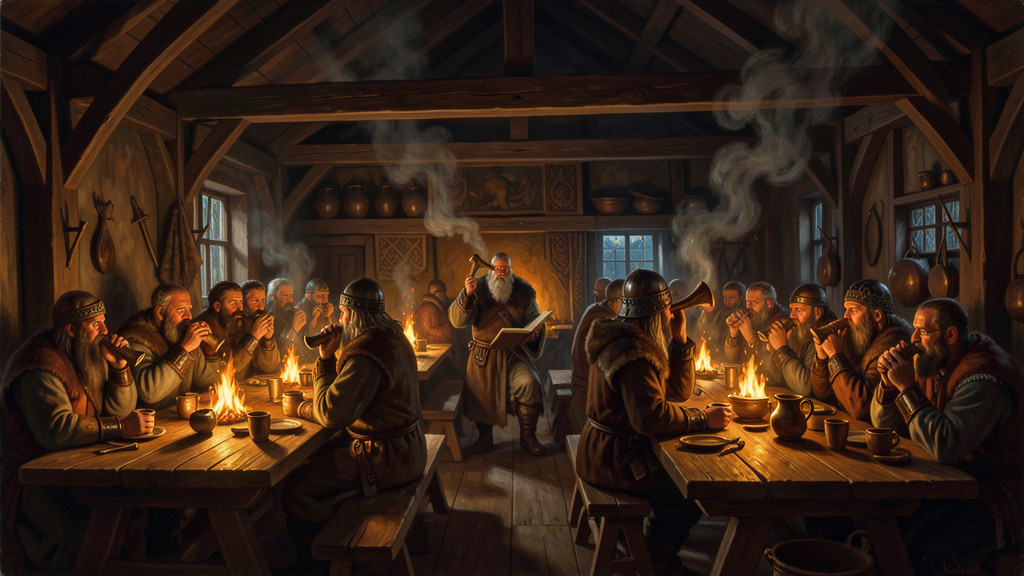
Step into a Viking longhouse at nightfall and the first thing that hits you is not the fire smoke. It is the sound — the low rumble of voices, the crash of a drinking horn against oak, the skald’s voice rising above the noise with a verse about Odin’s exploits. The mead hall was the beating heart of Norse society, where alliances were forged and the dead were remembered. And at the center of it all was drink — mead and ale passed around the fire in rituals that bound communities together. But the same culture that celebrated alcohol so fiercely also understood its dangers, and what happens when you stop drinking is a question the Norse explored in their own way through sagas and verse.
The Hávamál, the collection of Old Norse wisdom poems attributed to Odin himself, contains sharp counsel on the dangers of drinking. “There is not as much good as men claim there is in ale for one’s well-being,” Odin warns in Stanza 12. The sagas are full of men who drank too much and paid for it with their reputations, their fortunes, or their lives. The Norse understood something that modern science has spent decades proving — that alcohol is as dangerous as it is delightful. And when we trace the arc from the mead hall to the modern rehab center, we see both sides of the same coin the Vikings held.
The Mead Hall: The Social Center of the Viking World
The Norse did not have pubs or taverns. They had the skáli — the great hall of a chieftain or king, a long timber building with a central hearth that ran nearly the full length of the floor. These halls served as dining room, courtroom, council chamber, and festival ground all at once. The most famous of them, Heorot in the Old English poem Beowulf, is described as the “greatest of hall-buildings.” Its very name means “hall of the hart,” a symbol of royal power.
Archaeological excavations at Lejre in Denmark and at Birka in Sweden have uncovered the remains of these massive structures. The hall at Lejre, believed to be from the sixth century, measured nearly fifty meters long and ten meters wide — large enough to seat a hundred or more warriors and their families. The benches that lined both sides of the hall were status markers. The seat closest to the fire and opposite the high seat belonged to the most honored guests. The farther you sat from the center, the lower your standing.
At a feast, the order of seating, the order of toasts, and even the order in which the drinking horn passed were matters of intense social importance. To serve someone from the wrong side of the horn was an insult that could start a blood feud. The food served alongside the ale was equally symbolic — Viking feasts featured roasts, stews, and preserved fish, all designed to sustain a hall full of warriors through long northern nights.
What the Vikings Actually Drank
The popular image of Vikings drinking nothing but mead from bull horns is partly true and partly romanticized. The reality is more practical.
Ale was the everyday drink of the Viking Age, consumed by everyone from thralls to kings. It was made from malted barley, fermented with wild yeast, and often flavored with bog myrtle or juniper berries. Unlike modern beer, Viking ale was not heavily hopped — hops were not widely used in Scandinavia until the later Middle Ages. This meant the ale was sweeter and had a shorter shelf life, so it was brewed in small batches throughout the year. Almost every farm had its own brewing setup, as described in this guide to traditional Viking drinks. For most Norse people, ale was safer than water, since the boiling process killed harmful bacteria, and it provided calories that were essential in a harsh northern climate.
Mead — the drink most associated with the Vikings today — was more of a special occasion beverage. Mead is made from honey, water, and yeast, and honey was a valuable commodity in Scandinavia. Beehives produced limited yields in the cold climate, so mead was reserved for feasts, rituals, and celebrations. It carried deep cultural and religious significance, as explored in the legacy of mead in Norse culture. In Norse mythology, the Mead of Poetry (Skáldskaparmjöðr) was a mythical beverage that granted wisdom and poetic inspiration to anyone who drank it. According to the Prose Edda, the mead was created from the blood of the wise god Kvasir, mixed with honey, and passed through the hands of dwarves, giants, and eventually Odin himself.
Wine was available but rare. It was imported from southern Europe and was a luxury good, enjoyed primarily by the wealthy and by those who had raided or traded in Frankish or Anglo-Saxon territories. Wine was prestigious, but it never replaced ale or mead as the drink of the people.
Toasts, Oaths, and the Sacred Cup
Drinking in the Viking Age was never casual. It was ritualized. A feast began with the host raising a horn and making a toast — often to Odin, Thor, or the ancestors. The horn would pass from person to person around the hall. Each person would speak before drinking: a boast, a promise, a memorial to a fallen comrade, or a challenge. These were called bragarfull — “oath-cups” — and what was said over them was binding.
The Gautreks Saga records that King Gauti once made a drunken boast over an oath-cup that he would not rest until he had avenged a slain kinsman. When morning came and the ale wore off, the rash promise had set in motion a chain of events that ended in bloodshed. The sagas are full of such stories — men saying things over drink that they could not take back.
This was not a flaw the Vikings were unaware of. The Hávamál devotes multiple stanzas to the problem. Stanza 19: “He who drinks deeply forgets the wariness of his tongue. Beware the ale-cup.” Stanza 14: “Drunk was I then, over-drunk, in the hall of wise Fjalar. But best is an ale-feast when a man is able to call back his wits at once.” The god of wisdom himself admits to getting too drunk and needing to recover his senses. The honesty is striking, and so is the underlying point: the Norse knew that alcohol could strip away a person’s judgment, and they respected its power enough to build warnings into their most sacred texts.
Drinking as a Test of Character
In several sagas, a character’s ability to hold his drink — or his failure to do so — becomes a defining trait. In Egil’s Saga, the greatest of the Icelandic family sagas, the protagonist Egil Skallagrímsson is a man of immense appetites. He drinks heavily, fights savagely, and composes poetry with equal intensity. But his drinking is never portrayed as entirely admirable. When he is poisoned at a feast by his host King Eirik Bloodaxe, Egil survives by carving runes into his drinking horn — writing that, according to the saga, caused the horn to shatter. The episode is presented as cleverness and luck, but the subtext is clear: a man who drinks at his enemy’s table is a man who has put himself in mortal danger.
The Njáls Saga — Iceland’s most famous saga — features a feast where excessive drinking leads directly to the deadly feud that drives the entire narrative. A guest drinks too much and insults his host. The insult leads to a fight. The fight leads to killings. The killings lead to the burning of Njál’s farm with his family inside. One evening of heavy drinking, one loose word, and dozens of people die. Medieval Icelanders reading this saga knew exactly what it was warning against.
What the Norse Body Experienced During Withdrawal
The Vikings did not have the scientific vocabulary to describe alcohol withdrawal. They did not know about GABA receptors, dopamine pathways, or the central nervous system’s dependence on ethanol. But they observed the effects. A man who drank heavily every day and then stopped — because the ale ran out, because a journey prevented it, because the season of feasting ended — would shake. He would sweat. He would suffer crushing headaches and an uncontrollable craving for more drink. The sagas describe men becoming irritable and violent during periods of enforced sobriety, and the Norse recognized these symptoms as evidence of a man losing control, even if they had no framework for understanding the mechanism.
Modern science fills in what the sagas only imply. Heavy alcohol consumption changes the brain’s chemistry over time. The brain adapts to the presence of alcohol by suppressing its own natural calming signals and amplifying excitatory ones. When the alcohol is removed, the brain remains in this over-excited state, producing anxiety, tremors, insomnia, rapid heart rate, and in severe cases, seizures and delirium tremens — a condition with a fatality rate of 37% if untreated. The Vikings called it something simpler. They called it losing your wits. But the underlying reality is the same in any language: the body becomes dependent, and the cost of stopping is real.
This is why medical detox is so important. The Norse did not have the advantage of supervised withdrawal — when a Viking stopped drinking, he faced the symptoms alone and without support. Today, facilities like The Recovery Village Atlanta provide twenty-four-hour medical monitoring during detox, managing the most dangerous symptoms with medication and professional care, so that the body can restore its natural balance safely.
When the Drinking Became Too Much: Norse Social Controls
Viking society was not lawless when it came to alcohol. It had mechanisms for managing the harm. Feasts were governed by strict protocols about how much could be drunk and by whom. The host controlled the flow of the horn. A guest who became visibly disorderly could be escorted out by the host’s men — and the shame of being ejected from a feast was a serious social penalty.
Iceland’s medieval law code, the Grágás, prohibited drinking during certain periods of the year, including the fasting season of Lent for those who had converted to Christianity. Even for pagans, there were expectations of moderation. A man who showed up drunk to the Althing, Iceland’s annual parliament, could be fined or barred from participating in legal proceedings. Drunkenness was understood as a threat to the social order, and it was regulated accordingly.
But these controls had limits. In a culture where hospitality demanded that the host keep the drinking horn full, where feasting was the primary form of social bonding, and where alcohol was woven into religious ritual, there were no easy off-ramps for someone who had developed a serious drinking problem. The Norse did their best with the tools they had. Their sagas and law codes show they understood the problem. What they lacked was the medical knowledge to treat it.
From the Viking Age to the Present
The role of alcohol in Norse society was never simple. It was sacred and dangerous, bonding and divisive, life-giving and life-taking. The same mead that inspired a skald’s poetry could spark a blood feud that would last for generations. The same ale that warmed a longhouse through a winter night could lead a man to say words he could never unsay. The Vikings lived with this paradox every day, and they wrote about it honestly in the poems and stories they passed down to us.
If Odin could admit to being over-drunk in the hall of Fjalar, then the Norse understood something we still struggle with today: alcohol is not a vice to be moralized about or a harmless pleasure to be dismissed. It is a powerful substance that demands respect. The benefits of stepping away from it — better sleep, lower blood pressure, improved liver function, clearer thinking, financial savings, restored relationships — are the same benefits the Vikings might have described in their own way as “calling back one’s wits.” The language changes. The truth does not.
For a culture that elevated the drinking hall to the center of its social world, the Norse left behind a surprisingly balanced view of alcohol. They celebrated it, honored it, wove it into their myths and rituals. And they also warned against it, stanza after stanza, saga after saga. The wisdom of the Hávamál still rings true more than a thousand years later: there is not as much good as men claim there is in ale for one’s well-being. But knowing that — and acting on it — are two different things. The Norse knew the first part. Modern medicine has finally given us the tools to do the second.
