
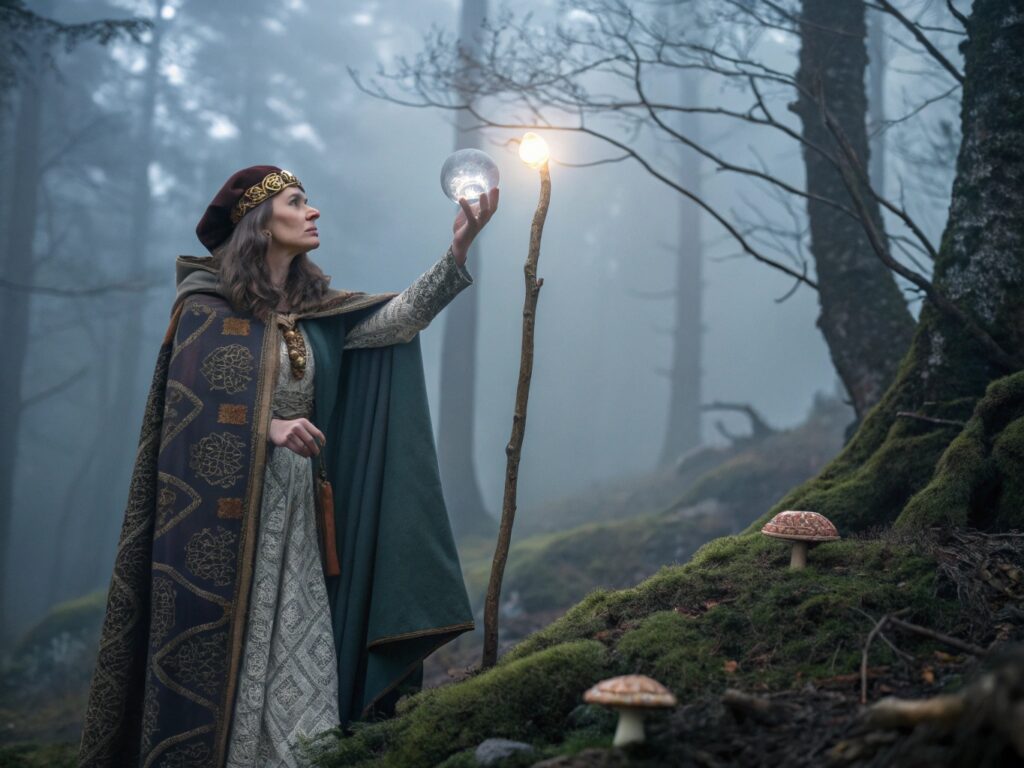
Long before Norse kings carved their names in stone, before the clash of swords and the sagas of gods, there walked women wrapped in cloaks of fur and mystery. They were Völur — Norse seeresses, female shamans, keepers of secret knowledge. With staff in hand and spirits at their side, the Völva was feared, revered, and sometimes exiled.
To the Viking world, the Völva wasn’t merely a fortune-teller. She was a bridge between realms, a speaker of prophecy, and a practitioner of seiðr — the strange and sacred magic of fate.
Who Was the Völva?
The word “Völva” (plural: Völur) roughly translates to “wand-bearer” or “staff carrier”, a nod to her ritual staff — a powerful symbol of her authority.
Völur were typically older women — widows or solitary wanderers — who lived outside the bounds of everyday society. Yet their isolation was not weakness. It was spiritual power. They were invited into villages when fate needed clarity or storms loomed on the horizon.
Unlike the gods of war and glory, the Völva belonged to the unseen world — dreams, death, nature, and the deep river of time.
The Magic of Seiðr: Norse Sorcery and Soul Weaving
The Völva’s primary tool was seiðr, a Norse magical practice involving altered states, chanting, and ritual prophecy. With this, she could:
-
Foresee events or shape destiny
-
Communicate with spirits or ancestral forces
-
Heal the sick or harm the wicked
-
Unravel or bind fate like a magical thread
Seiðr was emotionally charged and considered dangerous — even shameful for men. It involved deep trance, often induced by drums, chanting (galdr), or herbal smoke. In this state, the Völva would enter the spirit world, seeking guidance or glimpses of what was to come.
Völva and the Gods: Odin, Freyja, and the Gendered Power of Prophecy
Norse mythology shows a strange tension around seiðr. The god Odin, chief of the Aesir, learned seiðr from the goddess Freyja — a powerful Vanir deity associated with fertility, love, and war. Yet, for a man to practice seiðr was seen as unmanly, even taboo.
This tells us something important:
The magic of prophecy was deeply feminine.
Not weak — but wild, ancient, and morally ambiguous.
The Völva’s power was not about dominance, but connection — to the earth, to death, to the flow of fate. While warriors shaped their legacy with swords, the Völva shaped it with sight.
Prophecy in the Sagas: The Völva Who Warned the Gods
The most famous seeress in Norse lore appears in the Völuspá (“The Prophecy of the Völva”) — a poem from the Poetic Edda. Here, Odin raises a dead Völva from her grave to demand knowledge of the end times.
She speaks — not with flattery, but with unyielding truth:
“I saw the world tree trembling, the fate of gods unraveling…
Brothers will fight and slay each other. The sun will go dark…”
She foretells Ragnarök, the doom of the gods. And even Odin, mighty and wise, cannot deny her words.
This moment shows just how sacred and feared the Völva was:
She did not bow to kings — not even to gods.
Burial and Artifacts: Traces of the Völur in the Earth
Archaeologists have uncovered graves of women buried with staffs, amulets, and ritual tools — signs of Völva status. One famous example is the Oseberg Ship Burial, which contained two high-status women alongside a carved staff, exotic herbs, and ceremonial items.
These burials tell us that the Völva was not marginal — she was spiritually central. Her role in Viking society may have been rare, but it was vital, especially in matters of war, death, and destiny.
The Völva’s Clothing and Ritual Objects
Descriptions from sagas and grave finds suggest the Völva wore:
-
Long robes of blue or dark wool
-
Beaded necklaces and brooches
-
Iron or wooden staff (sometimes snake-headed)
-
Animal skins or cloaks (bear, fox, or reindeer)
-
Herbs and ritual pouches for trance work
-
Keys and rings symbolizing spiritual authority
Each item carried meaning. The staff, especially, marked her as a walker between worlds — someone who could summon visions, bend fate, or guide the soul.
Feared and Revered: A Woman Outside the Norm
The Völva was not your village herbalist or healer. She was liminal — walking between known and unknown, human and divine. As such, she inspired both awe and fear.
Villagers might call her to foresee harvest outcomes or interpret omens, but they also kept their distance. She was a necessary force, not a familiar friend.
This ambivalence reflects ancient views about feminine spiritual power: alluring, prophetic, but dangerous when crossed.
Modern Echoes: Why the Völva Still Matters
In today’s world, the Völva’s path resonates with those reclaiming:
-
Female spiritual leadership
-
Intuition and ancestral wisdom
-
Earth-based ritual practices
-
The power of listening to the unseen
From modern Norse pagans to scholars of mythology, interest in the Völva is rising. She speaks to a hunger for sacred feminine knowledge — wisdom that doesn’t shout, but listens deeply.
Conclusion: Walking the Völva’s Path
The Völva’s story is not just historical — it’s archetypal. She reminds us that true power doesn’t always sit on thrones or swing axes. Sometimes, it whispers, weaves, and waits in the dark.
To walk her path is to honor silence, dream, ritual, and the strength of seeing what others cannot.
And in a world obsessed with speed, dominance, and noise, the Völva’s wisdom feels more vital than ever.
