
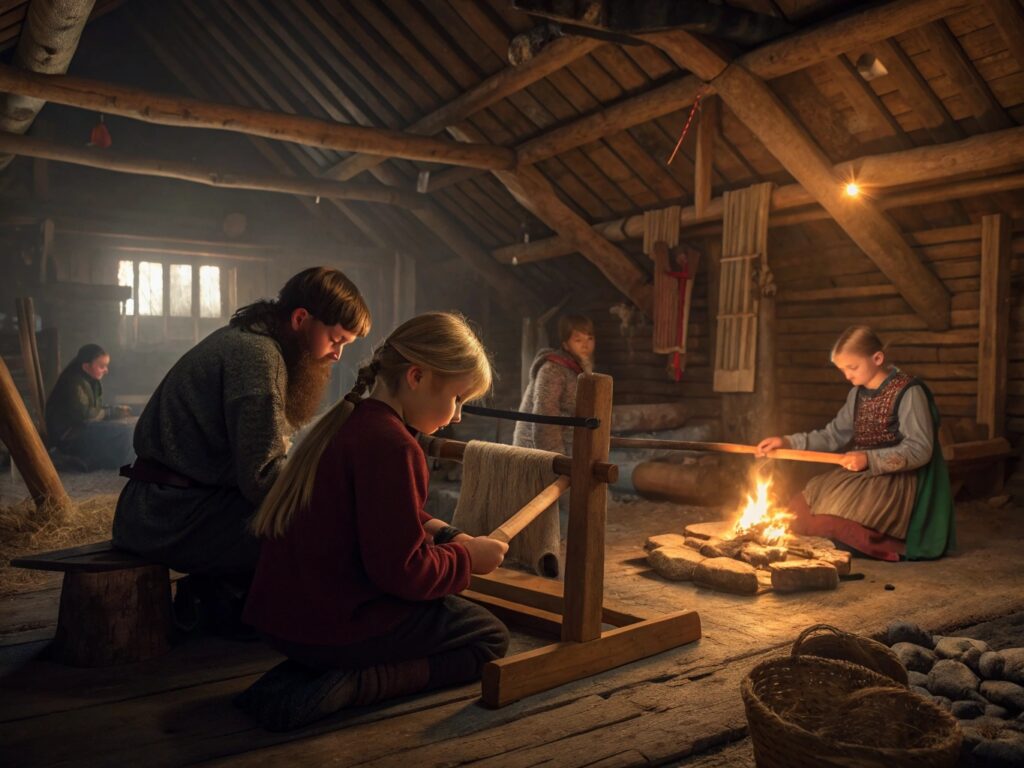
In the rugged landscapes of Scandinavia, where survival depended on courage, skill, and community, Viking childhood was anything but simple. Children were not sheltered from the hardships of life; instead, they were prepared from birth to contribute to their families and clans. From learning chores in the longhouse to absorbing the sagas of their ancestors, childhood in Viking society was a training ground for future warriors, farmers, and weavers.
This article explores how Norse families raised their children, the roles assigned to boys and girls, the games and education that shaped them, and the traditions that marked their passage into adulthood.
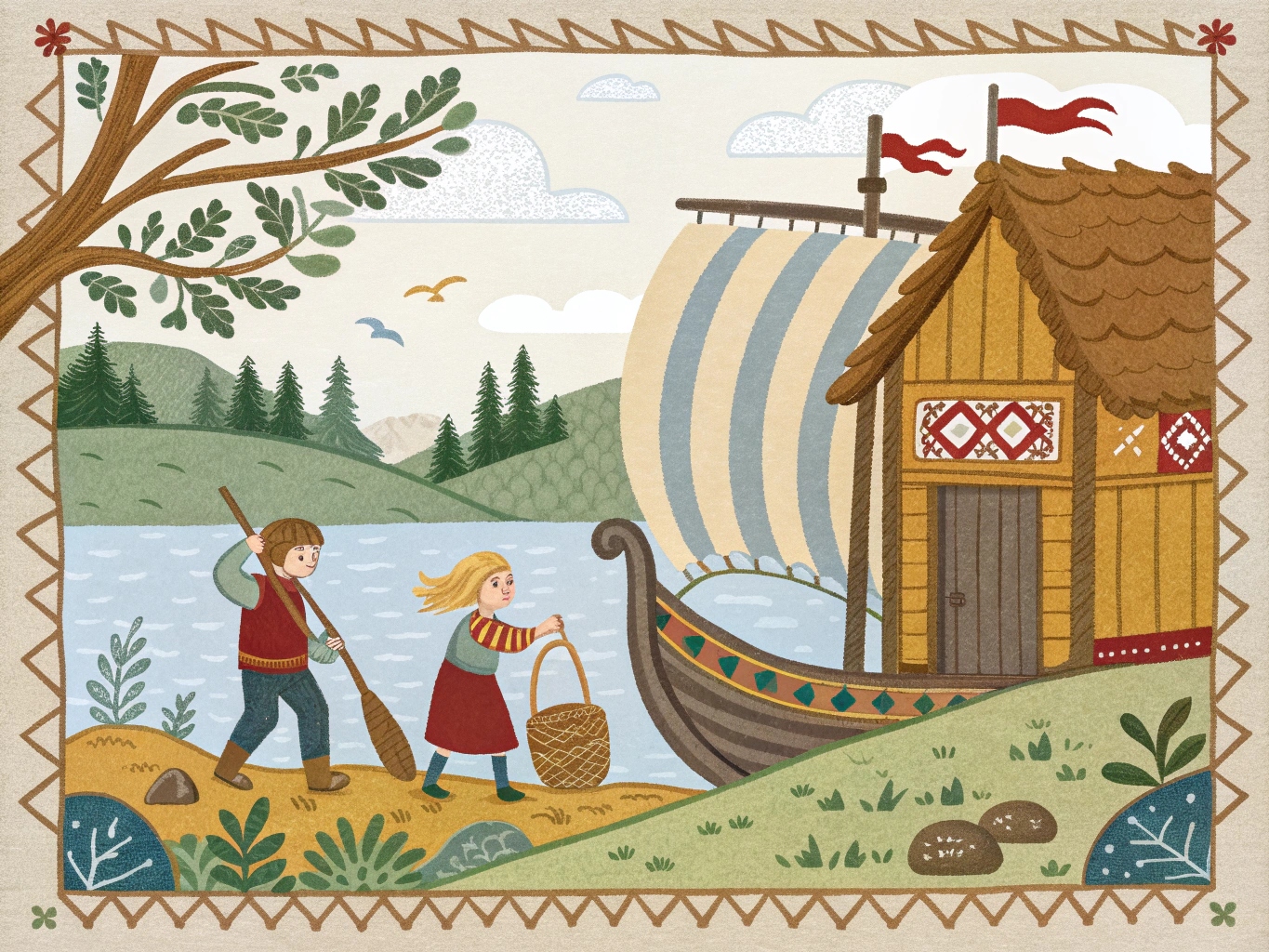
The Viking Family as Teacher
In Norse family life, the household was both home and school. Parents and extended kin—grandparents, aunts, uncles, and foster parents—shared responsibility for raising children. Every child’s upbringing in Viking society was shaped by the demands of survival: they learned to herd livestock, tend fields, repair tools, and weave clothing from a young age.
Unlike modern schooling, Viking children’s education came through imitation and participation. A boy might learn to wield a small axe by following his father to the fields, while a girl learned weaving by sitting beside her mother at the loom. Practical skills were essential, and children were expected to contribute long before reaching adulthood.
Boys: The Path of the Warrior
Viking boys grew up with the expectation of strength, courage, and loyalty. From the age of five or six, they began training with wooden swords, spears, and shields, often imitating the battles of their fathers. As they grew, these games became real training sessions, teaching them the discipline required for life as warriors, sailors, or farmers.
By adolescence, boys were often taken on voyages to learn seamanship, trading, and raiding. The sea was central to Viking life, and boys learned early to handle oars, sails, and weapons. The sagas describe young men eager to prove themselves in battle, knowing that honor and reputation began in youth.
Girls: The Weavers of Fate and Family
While Viking society often highlights warriors, Viking girls carried responsibilities just as vital. They were trained in the arts of spinning, weaving, and managing households—skills that ensured the survival of entire communities. In sagas and archaeology, we see women honored as keepers of property, textiles, and family wealth.
Girls also learned storytelling, herbal medicine, and rituals, passing down knowledge essential to Norse family life. Far from being confined, Viking women wielded influence in domestic and social spheres, and daughters were prepared from childhood to one day hold these roles.
Some girls also trained as shieldmaidens, though this was rare and often tied to exceptional families. More commonly, women’s power came through weaving both literal cloth and the social fabric of kinship and honor.
Play and Learning: Games of the Future
Although Viking children worked hard, they also played games that mirrored adult life. Archaeological finds include toy swords, miniature ships, and carved animals, suggesting that play was both entertainment and training.
Boys engaged in physical contests, testing their strength and courage, while girls played with dolls and weaving tools. Board games like hnefatafl taught strategy, patience, and foresight—qualities valued in leaders and warriors.
Through these games, daily life of Viking children blended joy with preparation, ensuring that fun also taught lessons about survival, cooperation, and destiny.
Education in Viking Society
Formal schools did not exist in the Viking Age, but education thrived in oral traditions. Children learned history and values through sagas, myths, and poems recited by elders. The Norse mythology for children was not mere entertainment—it was moral instruction, teaching lessons about courage, loyalty, and the inevitability of fate.
Boys learned runes if their families valued literacy, particularly in trading communities. Runes were rare and sacred, used for inscriptions, charms, and messages. Girls, too, might learn them, especially in aristocratic families.
In this way, Viking education and training blended practical survival skills with cultural wisdom, passing on both tools and identity.
Chores and Responsibilities
By the age of seven, most children were expected to handle real work. Chores in Viking families varied depending on wealth and region, but common tasks included tending goats and sheep, collecting firewood, fetching water, and helping with farming.
Girls spun wool and flax, dyed fabrics, and learned food preparation, while boys cared for animals, cut wood, and assisted in construction. The household functioned as a unit, with every child’s labor contributing to survival.
These early responsibilities created a culture where children grew into adults with strong discipline and resilience, well-prepared for the challenges of Norse life.
Fosterage: A Unique Norse Tradition
One remarkable feature of childhood in Viking society was fosterage. Families often sent their children to be raised by other households, strengthening bonds between clans. Boys might be fostered by warriors to learn combat, while girls could be placed with skilled weavers or influential women.
This practice expanded kinship beyond blood, ensuring that children developed networks of loyalty. Foster-siblings often became lifelong allies, and foster parents treated their charges as their own. The Viking fosterage tradition illustrates how community and family were intertwined in Norse culture.
Rites of Passage: From Child to Adult
As children grew, they underwent Viking rites of passage that marked their transition into adulthood. For boys, proving oneself in battle or voyage was crucial. Taking part in a raid or long sea journey often symbolized entry into manhood.
Girls transitioned into adulthood through marriage, managing households, and participating in family alliances. A girl’s dowry, prepared by her family, reflected years of skill and effort. In both cases, the passage from child to adult was not marked by age alone but by responsibility and recognition from the community.
Viking Childhood in the Sagas
The Icelandic sagas provide glimpses of Viking childhood, though often filtered through adult memories. Stories of young warriors testing their courage, boys striking their first blows in feuds, and girls weaving gifts for brothers or husbands highlight the values instilled from an early age.
These tales reveal how childhood in Viking society was inseparable from destiny. A child’s play, chores, and upbringing prepared them to live within a world ruled by honor, kinship, and fate.
Conclusion: Weaving the Next Generation
In the Viking Age, childhood was preparation, not protection. Every task, game, and story was designed to shape children into adults who could uphold the values of their families and communities. Viking boys were trained for war and seafaring, while Viking girls mastered weaving, property management, and kinship duties.
Through fosterage, chores, education, and sagas, the next generation of warriors and weavers carried forward Norse traditions. In a harsh and uncertain world, children were not merely the future—they were essential contributors to the present.
The story of Viking childhood reminds us that survival and honor in Norse society depended on every member of the household, from the youngest child to the oldest elder, bound together by blood, bond, and duty.
