
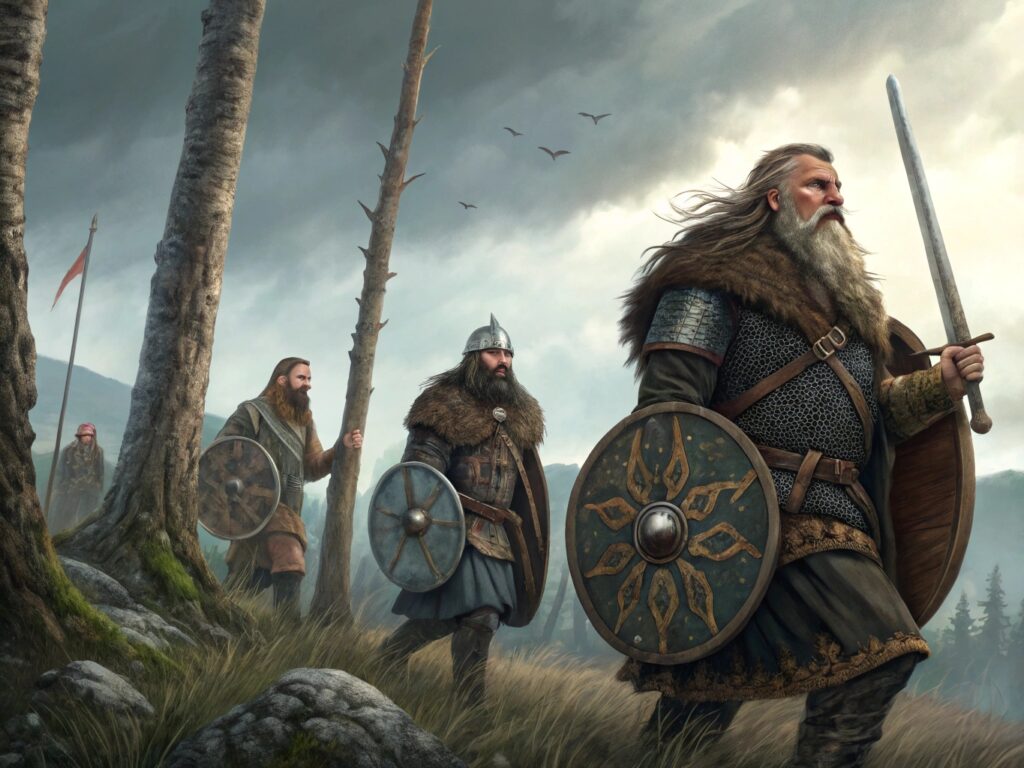
No civilization ever forgets its outlaws; they are carved into stone, sung into ballads, and blown to foreign beaches by winds of outlawry.
How Viking Law Defined Outlaws?
It was a blood-and-soil, honor-based life. It did not mete out punishment behind stone columns—it did so outside within general assemblies called “things” where free men made determinations of fate. If an individual was found guilty of significant transgressions—the ones especially being murder, robbery, or a violation against sacred tradition—their fate might not have been death. They were, however, made into outlaws.
To be declared an outlaw among the Norse was a worse fate, it seems, even than death. You were “skóggangr,” literally “to go into the forest”—outed from all society, stripped of legal status, with nowhere to go to find shelter, help, or protection. Anyone could kill you with no punishment. You were a legal nothing.
But overall, none of those proscribed entities did meet their end.
They wandered, they escaped, and by so doing, were among the most legendary figures from the Viking sagas. They were mythmakers, finders of new worlds, and shapers of the Norse fancy. The Viking robbers and fugitives transmuted ignominy into saga.

The Norse world: a continent that bred exile and exploration
Viking societies ranged from Norway’s frozen fjords to Swedish forests to Danish plains. They were close-knit agrarian and warrior societies where land and reputation were paramount. Conflict involving inheritances, boundaries, or vengeance usually resulted in bloodshed.
Once violence was involved, outlawry was a means of containment by a court. But banishment was never a conclusion, but all too often a commencement to a mythic odyssey.
Prodded from home, exiles were transformed into wanderers and colonizers. Their destinations sounded like the agenda of early Norse colonials:
- Iceland
- The Faroese Islands
- Greenland
- Vinland (possibly Newfoundland)
These were no escapist havens, but change-agents to new societies. They were sometimes isolated, unsettled lands. Other times, Norwegian robbers fought their way in, mixing with natives and making new laws.
Exile promoted exploration.
Egil Skallagrimsson: The Warrior, The Po
One of the more renowned Viking banishment stories is that of Egil Skallagrimsson, a war poet, berserker, and outlaw who’s legend endures between the pages of the Egil’s Saga.
Born in Iceland around 910 CE, Egil was a powerful warrior with a mouth to equal his blade. He killed his first man at the age of seven and fought continually with kings and chiefs.
Having come to blows with Norwegian King Eirik Bloodaxe (a man himself formed by exile), Egil was outlawed. His transgression? Killing the king’s son during a blood feud.
But Egil did not meet his end in ignominy. He fled to Iceland, plundered England, and composed some of the most beautiful sorrowful poetry in Norse literature, including a mournful elegy over his dead boy.
His outlawry became a badge of mythic rebellion. He embodied the double nature of Viking outlawship—atrocious but eloquent, banished but immortalized.

Iceland: The Society of Outcasts and Settlers
Iceland has evolved to be known as the great Norse experiment—the land of ice and fire colonized by dreamers, rebels, and outlaws.
From 870 to 930 CE, waves of settlers, who were primarily political fugitives or escapees from feuds, left Norway as a consequence of power centralization by King Harald Fairhair. They did not see a future shouldering a king and so opted for self-government.
They transported with them:
- Blood feuds
- Saga traditions
- Lawspeakers and assembly-style government
It became a country of law from a country of robbers. It possesses the oldest existing parliamentary body, known as the Althing, founded in 930 CE.
Icelandic sagas like Grettir’s Saga and Njal’s Saga are populated by Viking exile stories—grand tales of men cast out from their societies who are then challenged to see their mettle by being alone, traveling, and surviving.
One among them which still remains evocative is that of.
Grettir á Smiðil, The Strength Placed by Grettir Ásmundarson was among the tragic figures from Norse mythology. His saga, The Saga of Grettir the Strong, provides a profile of a strong but doomed man.
Doomed to bad luck, Grettir killed all too often and with insufficient consideration. He ended up being outlawed himself and lived 20 years as an exile, battling against monsters, thieves, and loneliness.
Although he was so powerful and fearless, Grettir’s fate was to die alone—to be surprised by his opponents’ killers.
His story demonstrates a common motif in Norse thought: strength without society is a dead thing. Grettir was an outlaw and, by definition, a ghost.
Mythic Archetypes: The Hero’s Journey as an Exile
Norse exile was never merely punishment. It was also mythic proving ground. The pattern is unmistakable:
- Exile by sentence or fate
- Wandering into unknown worlds (mythic or real)
- Tests of strength, intelligence, and beliefs
- Return or recitation by narration
This reflects the archetypal hero’s journey. In the sagas, exiles are likely to find:
- Trolls, undead draugr, and spirits
- Tough landscapes
- Supernatural signs
- Tests of patience and loyalty
- Surviving doesn’t just redeem them, it makes them legends.
These are not tales just of people. They are resonances of a Norse cultural identity—a country formed from displacement, from sailing, from reinvention.
The Sea as Trial and Liberation
The sea to the Norsemen could be a punishment or a deliverance. If a man was outlawed, then the sea offered a way to escape. But it tested your mettle as well.
The time spent in exile was:
- Geographical: Migration from a territory to another
- Spiritual: Leaving behind your relatives, name, and deities
- Psychological: To find isolation and fear
They were mostly banished to Hebrides, Ireland, Orkney, and even Russia. They were mercenaries, traders, or pirates.
Sometimes they became kings in other lands—the instance with Rollo, who founded Normandy. A raider to begin with, Rollo might easily have been exiled before rising to power within Frankish lands.
Outlaws in the Blood: What Modern Science Tells Us
New DNA and isotope studies of Viking-age burial grounds present surprising diversity. Immigrants, exiles, and settlers generally married into existing groups, constructing hybrid selves:
- Norse-Slavic within the territories of Rus
- Norse-Celtic in Ireland and Scotland
- Norse-Inuit in Greenland
This cultural exchange was very often instigated by exile. The fact that there were no social ties facilitated those Vikings to transcend cultural limits, adopt new customs, and prosper outside their country of origin.
Contemporary genetics bears out what the sagas insinuated: Viking robbers contributed to multicultural inheritances.
The Artifact of the Outcast: Rock and Clay Inscriptions
Whereas the sagas keep alive the memory, archeology reveals the facts. A few examples are:
- Eiríksstaðir (Iceland): Erik the Red’s settlement, twice outlawed—once in Norway, once in Iceland.
- Runestones from Denmark and Sweden that mention men who were “lost to exile” or “died in the west.”
- Norse-looking weapon graves from Isle of Man and Scotland but using local materials—most likely exiled warriors who established new settlements.
These marks suggest that Viking expulsion did not eradicate a life—it imprinted signs across continents.
Exile within Viking Customary Law and Christian Europe
Characteristically, Viking banishment stories differed from Christian punishment traditions. While Christian Europe saw sin and afterlife punishment, Norse law saw social disruption and balance.
Outlawry was not personal vengeance—it was institutional restitution. You could even:
- Buy back your peace by weregild (man-price)
- Look to reconciliation from banishment by courage or accommodation
- Be remembered by actions, not ideology.
This reveals a pragmatic, honor-driven justice system focused on community equilibrium, not morality.
Why Viking Outlaws Still Haunt Us?
From The Northman to Assassin’s Creed: Valhalla, modern media seems to be addicted to the lone Viking who wanders the wilds tortured and raging.
Why?
Because these figures tap into a primordial chord:
- The fear of being ejected
- Yearning to transform oneself
- The desire to return as a legend
The Viking outlaw was a paradox: Outcast among his own. Remembered by everyone.
Conclusion: The Exile, or The Forge of Legend
Viking exiles and outlaws were something more than criminals, they were cultural alchemists. In the fire of isolation and shame, they were transfigured into poets such as Pione Founders and Heroes Ghosts.
These narratives populated the Norse universe, colored the sagas, and inscribed mythic paths across medieval European geography. Next time you hear of a Viking raider sailing a foreign shore, do remember: he might very well not have gone voluntarily. It’s likely that he was banished, just to discover greatness outside.
