
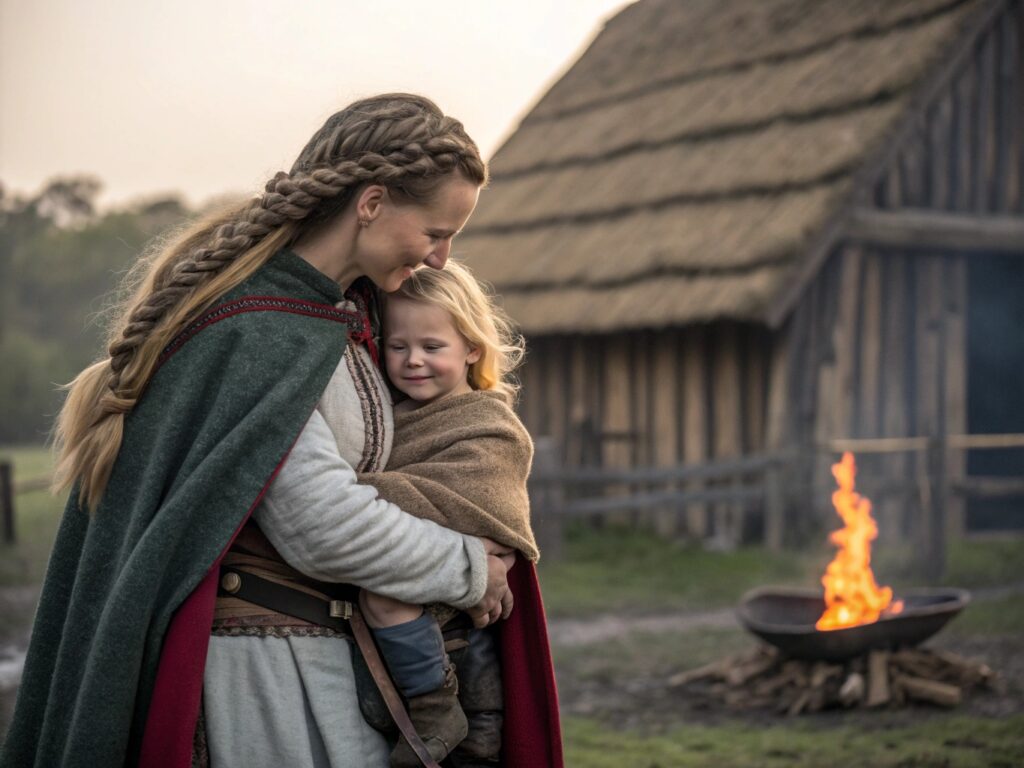
When most people imagine the Vikings, they picture fierce bearded warriors storming across the seas. Yet hidden behind these images lies another truth: women played equally vital roles in shaping Norse life. From nurturing households as Viking mothers to fighting alongside men as legendary Viking shieldmaidens, women carried a dual burden of responsibility and power. Far from passive figures, Viking women were central to both family and warfare, weaving together the threads of survival and honor.
Viking Women in Family Life
At the core of Viking family life stood the mother. She was far more than caretaker—she was the manager of the household. In a world where men often sailed for weeks or years, women ensured farms, livestock, and longhouses continued to thrive.
Viking mothers supervised servants and slaves, preserved food for winter, and taught children essential skills. Girls learned weaving, spinning, and property management from their mothers, while boys absorbed discipline and family values. Mothers also passed down oral traditions, storytelling, and mythology, shaping the cultural memory of Norse society.
This authority meant that women were entrusted with real power. They could handle finances, represent families in negotiations, and even hold keys to the storeroom—symbols of household leadership.
The Rights and Influence of Viking Women
Compared to many medieval societies, women in Viking society enjoyed notable rights. They could inherit property, divorce husbands, and reclaim their dowries. A woman wronged in marriage or law had avenues for justice.
As mothers, they ensured wealth and land remained within families. As wives, they managed household alliances through marriages and dowries. These legal rights elevated the status of Viking women beyond mere dependence on their husbands, allowing them to be active participants in the social fabric.
Shieldmaidens: Warrior Women of Norse Lore
Alongside their domestic responsibilities, some women took up arms as Viking shieldmaidens. These legendary figures appear in sagas and poems, described as fierce warriors fighting beside men in battles.
The female warriors of Norse mythology blur the line between history and legend. Archaeological finds, such as the grave at Birka in Sweden, suggest that at least some women did live and die as warriors. While shieldmaidens may not have been common, their presence in Viking lore reflects society’s respect for women who embodied both nurturing and martial power.
Shieldmaidens represented the extreme expression of courage and independence—qualities admired in Norse culture regardless of gender.
The Dual Role of Women in Norse Society
The coexistence of motherhood and warfare illustrates the dual role of women in Viking society. On one hand, women were guardians of the hearth, ensuring survival through daily labor, childbirth, and raising the next generation. On the other, they could also embody ferocity, standing with shield and sword in defense of family and clan.
This duality gave women unique influence. A Viking woman could be remembered as both nurturing mother and fearless warrior, embodying the balance between creation and destruction that underpinned Norse cosmology.
Women in the Sagas and Myths
The Icelandic sagas are filled with strong women who shaped events through courage, cunning, or vengeance. Figures like Gudrun from Laxdæla Saga and Brynhild the shieldmaiden show how women influenced destiny through both domestic and martial spheres.
Even goddesses of Norse mythology reflect this dual role. Frigg was the nurturing mother and seer, while Freyja was both goddess of love and a warrior who claimed half the slain in battle. Such divine examples reinforced that Viking women’s roles were never one-dimensional.
Mothers as Guardians of Honor
For the Vikings, family honor was paramount, and Viking mothers played a key role in preserving it. A mother’s encouragement often pushed sons toward bravery in battle, reminding them that cowardice brought shame to the entire clan. Women were keepers of memory, praising or condemning deeds, ensuring that honor lived beyond the battlefield.
This cultural role meant that women influenced warfare indirectly even when they did not fight. By raising warriors and safeguarding family reputation, they were essential to the martial culture of the North.
Shieldmaidens in Battle
Though rare, Viking warrior women inspired awe. Shieldmaidens are depicted charging into combat, wielding swords and spears, their shields raised alongside men. Chronicles from outside Scandinavia, such as Saxo Grammaticus’ Gesta Danorum, describe female fighters leading troops and challenging gender norms.
These stories show that Norse women in warfare were not dismissed as fantasy but acknowledged as extraordinary exceptions. They reinforced the Norse belief that fate and courage, not gender alone, defined greatness.
The Legacy of Viking Women
Modern fascination with Viking women stems from this duality. They were mothers shaping households and warriors shaping legends. They influenced politics through marriages, secured wealth through dowries, and preserved culture through stories. Some even broke into the male domain of combat, ensuring their names endured in history and myth.
Their legacy challenges stereotypes of the medieval woman as powerless. Instead, Viking women embodied adaptability, strength, and resilience—qualities that made them indispensable in both family and warfare.
Conclusion: Weavers of Life and War
The story of Viking mothers and shieldmaidens is a story of balance. Women in Viking society were not confined to a single role—they nurtured families and sometimes defended them with steel. As mothers, they preserved tradition, raised warriors, and secured households. As shieldmaidens, they stood at the front lines, embodying courage and defiance.
This dual role reveals the depth of Viking women’s influence, reminding us that Norse society thrived not just on the strength of its men but also on the resilience and power of its women. In the sagas of family and war, women’s voices and deeds were woven as tightly as the sails that carried Viking ships across the seas.
