

When we think about advanced beauty rituals, we often imagine modern clinics filled with innovative tools and premium products – even browsing for spa equipment for estheticians to upgrade a treatment room. But long before high-tech facials and laboratory serums, Norse women had their own effective, natural approach to skin health. Viking skincare was practical, ingredient-focused, and deeply connected to the harsh Nordic environment. Surprisingly, many elements of the Viking skincare routine align closely with today’s clean beauty movement.
In this article, we explore the real story behind Norse women beauty secrets, the ingredients they likely used, and how ancient Viking beauty practices still influence natural skincare today.
The Myth of the “Unkempt Viking”
For decades, popular culture painted Vikings as rough, dirty warriors. Archaeological discoveries tell a different story. Excavations across Scandinavia and the British Isles have uncovered combs, tweezers, razors, ear cleaners, and washing basins in Viking graves and settlements. Grooming tools were so common that historians now believe personal hygiene was an important social norm.
Cleanliness was not vanity – it was status. A well-groomed appearance signaled discipline, health, and respectability. For women especially, maintaining healthy skin and hair was closely tied to fertility, attractiveness, and social standing.
This context makes it clear that natural skincare in Viking times was intentional, not accidental.
The Harsh Nordic Climate and Its Impact on Skin
To understand ancient Viking beauty practices, we must understand the environment. Scandinavia’s climate was cold, windy, and often dry. Winters were long, and exposure to sea air could further strip moisture from the skin.
Without modern moisturizers, Norse women relied on protective barriers made from natural fats and oils. These ingredients created occlusive layers that helped lock in moisture and protect against windburn.
Interestingly, modern dermatology supports this method. Many barrier-repair creams today use similar lipid-based principles.
Animal Fats as Moisturizers
One of the most practical elements of the Viking skincare routine was the use of animal fats. Sheep tallow and other rendered fats were widely available in Norse households. While this may sound primitive, tallow is actually rich in fatty acids that closely resemble the lipids found in human skin.
Benefits of animal fats for skin likely included:
-
Deep moisturization
-
Wind protection
-
Prevention of cracking and dryness
-
Support for skin barrier repair
In today’s world, grass-fed tallow balms are resurging in popularity within natural skincare communities. What seems modern is often ancient.
Herbal Infusions and Plant Extracts
Scandinavia’s forests and meadows provided a wealth of botanical resources. Norse women beauty secrets likely included herbal infusions made from local plants such as:
-
Chamomile
-
Yarrow
-
Nettle
-
Birch leaves
-
Juniper
These herbs have known anti-inflammatory and soothing properties. Infusions could have been used for washing the face, soothing irritated skin, or improving overall complexion.
Natural skincare in Viking times depended heavily on what was locally available. There were no imported exotic oils – only ingredients harvested from nearby land.
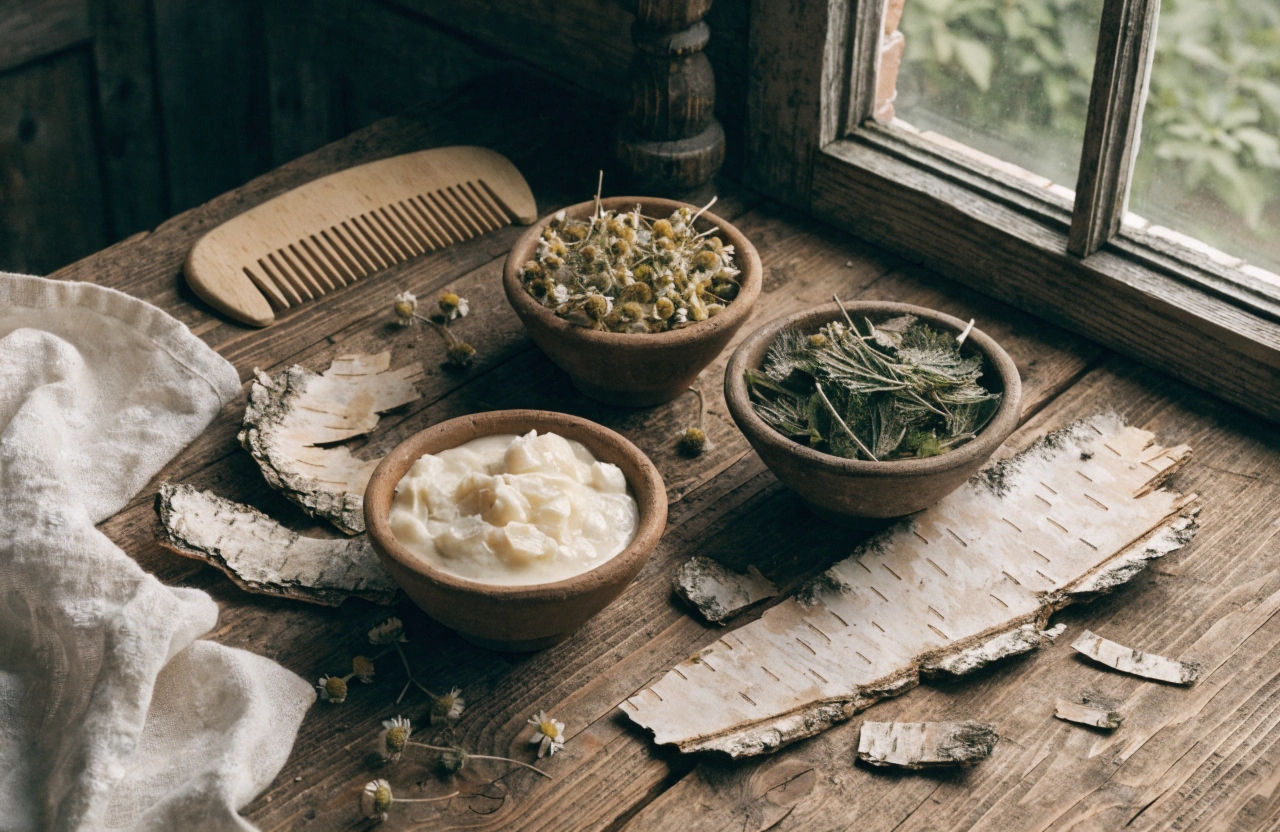
Birch Tar and Resin
Birch trees were central to Viking life. Birch tar was used for waterproofing ships and preserving wood, but it also had medicinal applications. While its cosmetic use would have been limited, small amounts may have been applied to minor skin irritations due to its antibacterial properties.
Resins from trees also had protective and sealing qualities. In small quantities, they could have been incorporated into balms for skin protection.
Modern skincare uses similar principles with pine resin derivatives and antimicrobial botanical extracts.
Ash and Soap-Like Cleansers
Soap as we know it was not widely available in early Viking society, but alkaline ash mixed with water created primitive cleansing solutions. These mixtures helped remove dirt and oil from the skin.
Animal fat combined with ash can form a basic soap-like substance. While likely harsh by today’s standards, it provided essential cleansing in a time without commercial products.
Cleansing was important in maintaining social respectability. Historical accounts even suggest that Vikings bathed more frequently than many other European populations of the time.
Fermented Ingredients and Mead
Fermentation was central to Norse culture, especially in the production of mead. Although direct evidence of fermented skincare products is limited, it is possible that fermented plant infusions were occasionally used for topical purposes.
Today, fermented ingredients are celebrated in modern cosmetics for enhancing absorption and supporting the skin microbiome. This makes the connection between ancient Viking beauty practices and modern probiotic skincare especially fascinating.
While we cannot confirm the exact formulations, the Nordic reliance on fermentation suggests an intuitive understanding of preservation and biological transformation.
Exfoliation in Viking Times
Exfoliation likely came in the form of natural abrasives:
-
Fine sand
-
Ground pumice-like stones
-
Crushed shells
-
Oat-based scrubs
These materials could remove dead skin cells and refresh the complexion. Oats, in particular, are known for their soothing and anti-inflammatory properties and remain a staple in modern skincare.
A simple oat paste mixed with water would have functioned as both cleanser and gentle exfoliant.
Beauty, Health, and Symbolism
In Norse culture, beauty was not just cosmetic. It symbolized vitality and divine favor. Mythology often described goddesses with radiant skin and golden hair. Physical well-being reflected inner strength and harmony with nature.
Norse women beauty secrets were not about artificial transformation but enhancement of natural features. Strong cheekbones, healthy glow, and well-maintained hair were admired traits.
This holistic view of beauty aligns closely with the philosophy behind many modern wellness-focused skincare brands.
Comparing Viking Skincare to Modern Natural Beauty
Many elements of the Viking skincare routine mirror current trends:
| Viking Practice | Modern Equivalent |
|---|---|
| Animal fat balms | Tallow-based moisturizers |
| Herbal infusions | Botanical toners |
| Oat scrubs | Colloidal oatmeal treatments |
| Resin balms | Natural barrier creams |
| Ash cleansers | Alkaline detox cleansers |
The biggest difference lies in refinement. Modern formulations improve texture, safety, and stability, but the core concepts remain similar.
Ancient Viking beauty practices remind us that skincare innovation often builds on traditional knowledge.
What We Can Learn Today
Natural skincare in Viking times teaches several valuable lessons:
-
Protection is more important than perfection
-
Local ingredients can be highly effective
-
Simplicity often works
-
Skin health reflects overall health
-
Ritual matters as much as the product
Instead of chasing endless trends, Norse women relied on consistent routines tailored to their environment.
The Viking Approach to Aging
There is little evidence of anti-aging obsession in Viking culture. Wrinkles were likely viewed as a sign of experience and resilience. However, maintaining skin integrity was still important.
Moisturizing with fats and protecting from wind would naturally reduce premature skin damage. Without chemical peels or injectables, preservation depended on prevention.
Modern skincare increasingly returns to this preventative philosophy, emphasizing barrier support over aggressive correction.
Were Norse Women Ahead of Their Time?
While it would be inaccurate to romanticize Viking skincare as scientifically advanced, it was practical, ingredient-conscious, and environmentally adapted.
The Viking skincare routine was built on observation. If something soothed irritation, it was reused. If something protected against cold, it became tradition.
This trial-and-error method resembles the foundation of empirical science.
The Modern Revival of Nordic Beauty
Today, Scandinavian beauty brands emphasize minimalism, clean formulations, and sustainability. The aesthetic is natural, fresh, and understated – echoing ancient values.
Norse women beauty secrets continue to inspire:
-
Minimal ingredient lists
-
Plant-based actives
-
Barrier-focused formulas
-
Climate-adapted skincare
Ancient Viking beauty practices are not relics – they are part of an ongoing evolution.
Final Thoughts
Viking skincare was not glamorous, but it was intentional. Norse women worked with what they had – animal fats, herbs, ash, oats, and forest botanicals – to protect and nourish their skin in one of Europe’s harshest climates.
Natural skincare in Viking times was rooted in survival, health, and social identity. Today’s clean beauty movement echoes many of those same principles, proving that sometimes the best innovations are rediscoveries.
From tallow balms to herbal infusions, the Viking skincare routine reminds us that effective beauty care does not always require complexity. Sometimes it requires wisdom, consistency, and respect for nature.
